

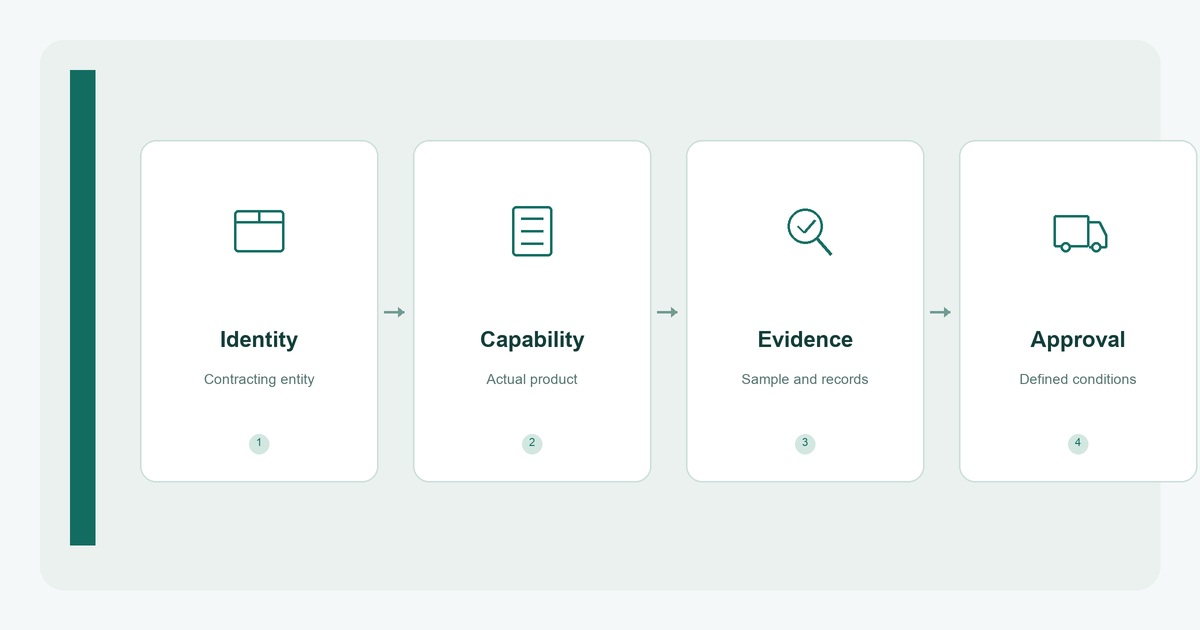
Supplier verification should not stop at a platform profile. For an importer, the question is whether the supplier is a credible match for the required product, quantity, quality, lead time, documentation, and destination-market operating model.
Key Takeaways
- Treat 1688 as one supplier discovery source, not proof of commercial suitability.
- Verify identity, capability, product evidence, quality process, and communication before payment.
- Keep verification records and refresh them when the supplier or product changes.
Use a layered due-diligence process
Start with business identity and contact consistency. Then assess product capability, relevant production experience, capacity, MOQ, lead time, sample quality, references, and willingness to document requirements. The goal is not to remove every risk; it is to know which risks remain before the order is approved.
| Area | What to examine | Evidence or decision output |
|---|---|---|
| Identity | Do business details, contact information, beneficiary, and factory or office information align? | Verification record |
| Capability | Can the supplier produce the specification, quantity, packaging, and required evidence? | Sample and capability notes |
| Reliability | How does the supplier respond to changes, defects, delays, and document requests? | Communication and risk log |
Verify before the first commercial order
- Create a standard supplier questionnaire and evidence checklist.
- Request a sample or product evidence tied to the intended specification.
- Check capacity, lead time, MOQ, QC, packaging, and shipping assumptions.
- Approve the supplier with conditions, controls, and a review date.
Due diligence for Spain and Japan
This article uses Spain and Japan as the destination-market lenses. For Spain, include destination packaging, documentation, and distribution requirements in the supplier brief. For Japan, pay close attention to technical accuracy, response discipline, and the supplier’s ability to maintain the approved version across production.
Define the supplier relationship being verified
Record whether the counterparty is the manufacturer, a trading company, an agent, or another commercial intermediary. Identify which entity will contract, invoice, receive payment, produce goods, and answer quality claims. Different roles can be legitimate, but the buyer needs to understand the arrangement. A factory photograph does not establish that the company issuing the invoice operates that factory.
Keep the company’s stated details, contact records, production address, and proposed payment beneficiary together. Investigate unexplained differences before releasing funds. If a supplier changes bank details, use the business’s established independent confirmation process. Do not treat a message inside the same conversation as sufficient evidence of an unexpected change.
A layered verification record
- Identity: record the legal entity, relevant business documentation, contact channels, and how the buyer checked consistency.
- Product capability: request evidence for the actual materials, processes, variants, and quantities under consideration. Distinguish catalog claims from project evidence.
- Production control: identify critical work performed internally or subcontracted and the records used to keep the approved specification consistent.
- Quality: review sample results, measurement methods, defect handling, inspection access, and willingness to preserve evidence.
- Commercial reliability: record quotation clarity, lead-time assumptions, change responses, and unresolved conditions before approval.
Use an evidence ladder rather than a badge score
Start with documents and written answers, then request samples or relevant production evidence. Where risk warrants it, arrange an appropriate independent check or site visit within an agreed scope. Record what each activity can and cannot establish. Passing a sample evaluation does not prove future capacity; visiting a facility does not remove the need for order-specific inspection.
Assess the age and relevance of the evidence. A document for another product, an old production video, or an unrelated customer reference may not answer the current question. Ask the supplier to identify the product, date, site, and process shown. Preserve uncertainty rather than turning every submitted file into a positive verification result.
Apply the checklist to a realistic approval decision
Imagine a hypothetical supplier offers an attractive price and a satisfactory sample but cannot explain a proposed material substitution for the production order. Record the open issue as a production-control risk. Request confirmation of the approved material, purchasing source, and change-approval process. The buyer can then approve conditionally, request further evidence, or reject the proposal.
For a Spain importer, the destination reviewer might require product documentation that the supplier has not supplied. For a Japan buyer, an unresolved drawing revision might prevent technical approval. These are concrete project conditions, not assumptions that all businesses in one country behave alike. Link each condition to the evidence and the person responsible for closing it.
Keep verification alive after supplier approval
Give the supplier an approval scope: product family, site, specification version, and conditions. Set a review trigger for material changes, new subcontractors, ownership changes, bank-detail changes, repeated defects, or major lead-time variance. Avoid giving a supplier unrestricted approval for products your team has never evaluated.
Review receiving and inspection results after meaningful orders. Compare promises with actual quantities, product versions, communication, corrective actions, and timing. Save the evidence behind both good and poor performance. A sourcing platform or coordinator can help gather records and follow up with the supplier, while the importer retains the decision about acceptable commercial risk.
Separate missing evidence from negative evidence
An unanswered questionnaire field is an unresolved issue; contradictory documents or unexplained product changes may indicate a more serious concern. Record those situations differently and specify the follow-up each requires. Do not average a serious unresolved identity issue into a positive overall supplier score. Have the purchasing owner decide whether the remaining uncertainty fits the product, payment, quantity, and destination exposure of the proposed order.
How Fishgoo Helps
For this workflow, Fishgoo can help coordinate supplier communication, sourcing coordination and quality-check evidence, subject to the confirmed product and destination scope. Its service overview describes China-side sourcing, quality, warehouse and shipping support. Bring the approved product brief, quantity, supplier status, destination and open issues to the discussion. Confirm deliverables, fees, reporting and approval rights before work begins. The buyer retains commercial decisions and destination-market responsibilities; no automatic channel integration or guaranteed outcome is assumed.
Discuss your China sourcing and fulfillment workflow with Fishgoo.
FAQ
Does a verified 1688 profile guarantee quality?
No. A profile may support discovery, but quality and production suitability require product evidence, communication checks, samples, and ongoing inspection.
Should an importer visit the factory?
A visit can add useful evidence, but it is not the only option. Use a risk-based combination of documents, samples, third-party checks, and production evidence.
When should supplier verification be repeated?
Repeat it when the product, ownership, factory, bank details, capacity, or commercial terms change, and review supplier performance after each material order.
See Also
Custom Packaging in China: Procurement, Quality, and Brand-Control Workflow
MOQ Negotiation in China: How Importers Build a Viable First Order
China Product Sampling for Commercial Buyers: From Brief to Approval
China Supplier RFQ Template: What to Include Before Requesting Quotes
How Importers Reduce China Freight Costs Without Sacrificing Service