

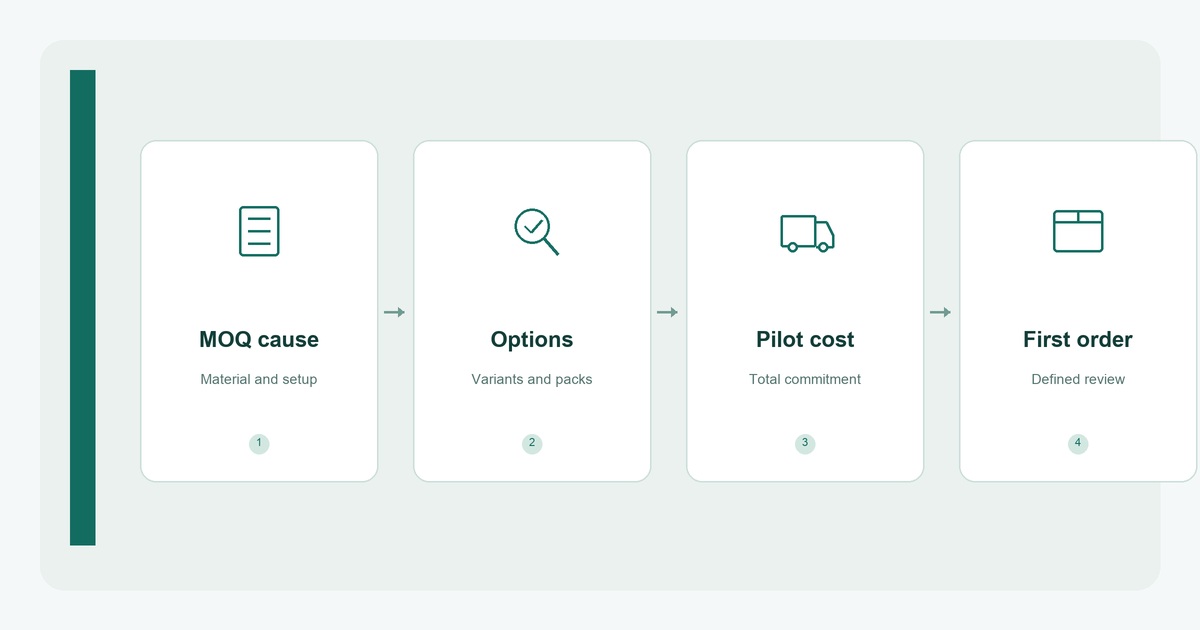
MOQ is a supplier and product decision, not a universal platform rule. Importers should understand why the supplier set the MOQ, what price or setup cost changes at a smaller quantity, and how a pilot order connects to later production.
Key Takeaways
- Treat MOQ as part of the supplier’s unit economics and production setup.
- Negotiate with a clear pilot, forecast, and reorder path.
- Compare MOQ against landed cost, inventory risk, and quality evidence.
What determines MOQ
MOQ can be influenced by material purchases, production setup, tooling, packaging, labor, supplier capacity, and price breaks. Ask the supplier to separate a true minimum from a preferred economic quantity. A lower MOQ may carry a higher unit price, a setup charge, or a different production arrangement.
| Area | What to examine | Evidence or decision output |
|---|---|---|
| Supplier economics | Which materials, setup, tooling, packaging, or labor constraints create the MOQ? | MOQ explanation |
| Pilot | What quantity is enough to test quality, market response, and delivery? | Pilot-order plan |
| Scale | What forecast or reorder commitment could support a better commercial condition? | Negotiation scenario |
Negotiate a viable first order
- Ask for MOQ, price breaks, setup costs, sample conditions, and lead time together.
- Explain the pilot purpose and expected reorder path without promising volume you cannot support.
- Compare smaller quantity, standard MOQ, and staged-order scenarios.
- Document the agreed MOQ and what changes when the quantity changes.
MOQ for Spain and Japan importers
This article uses Spain and Japan as the destination-market lenses. Spanish and Japanese importers should include destination packaging, freight, local receiving, and inventory cost when comparing MOQ. A lower factory quantity may create a higher landed cost if it fragments the shipment or weakens the production plan.
Ask which constraint creates the minimum
Request an explanation for product, material, color, size, packaging, and total-order minimums separately. A supplier’s preferred batch size may differ from a material supplier’s purchase minimum or a packaging print requirement. Identify the constraint before proposing a lower quantity. Negotiation is more useful when it changes the relevant production input rather than repeating a request for a discount.
Ask how the cost and timing change at different quantities. Request separately stated setup, tooling, sampling, and recurring product costs. Confirm whether the supplier can use an existing material, a standard component, or a simpler pack without changing the essential product requirement. Have the product owner approve any option that alters the specification.
A first-order negotiation worksheet
- Pilot objective: state what the first order must validate, such as product quality, receiving process, or repeat commercial demand.
- Minimums: record each product, variant, material, and packaging constraint and the supplier’s explanation.
- Alternatives: compare a smaller batch, fewer variants, standard packaging, separately paid setup, or a revised supply arrangement.
- Economics: show total product commitment, one-time expenditure, freight, destination handling, storage, and expected cash exposure.
- Repeat plan: distinguish a non-binding demand forecast from an actual order commitment and confirm the review after the pilot.
Compare the total commitment rather than unit price
Use invented figures in one currency to illustrate the decision. A supplier offers 500 units at 8 each, or a negotiated pilot of 200 units at 9.50 each plus a 150 setup charge. The product commitment is 4,000 for the first option and 2,050 for the pilot. These are hypothetical offers, not market rates or Fishgoo pricing.
The pilot has a higher apparent unit cost but requires less initial product expenditure. Add its actual packing, freight, destination, and storage costs before deciding. Examine what the business can learn from 200 units and whether that quantity supports the intended quality and commercial checks. A smaller order is useful when it tests a defined question, not merely when it feels less expensive.
Protect the approved product during negotiation
Require suppliers to state any changes behind a reduced minimum. A different material, subcontractor, packing process, or unapproved variant can undermine the trial. Tie the pilot to the approved sample and specification, with inspection requirements chosen for the product. Keep the buyer’s acceptance conditions separate from the quantity negotiation.
For a Spain distributor or Japan importer, confirm the actual destination pack and receiving constraints. Combining variants to reach the supplier minimum may still create local sorting or inventory problems. Ask the destination team whether the resulting assortment supports customer commitments. Avoid reducing the factory constraint by moving an unmanageable stock burden to the receiving warehouse.
Convert the pilot into a repeatable order decision
Agree the pilot review date and evidence needed: accepted quantities, defects, handling workload, commercial demand, remaining stock, and total operating cost. Explain which outcomes would support a repeat order and which require a product or supplier change. Do not promise a large follow-on order before the buyer has approved the commercial risk.
Use pilot findings when renegotiating production volume, variant mix, packaging quantities, and lead time. Separate confirmed improvements from optimistic forecasts. A sourcing coordinator can help clarify supplier constraints and arrange the agreed steps, while the importer decides the acceptable expenditure, inventory commitment, and conditions for scaling the next order.
Document the commercial boundary of a forecast
If the supplier offers better terms based on expected repeat volume, state clearly whether that volume is a forecast or an enforceable commitment in the actual agreement. Obtain appropriate commercial review before accepting obligations the business cannot support. Keep the pilot decision independent from sales optimism. A clear boundary protects both sides from treating a planning conversation as an approved purchase order.
How Fishgoo Helps
For this workflow, Fishgoo can help coordinate supplier clarification, sample coordination and first-order shipment planning, subject to the confirmed product and destination scope. Its service overview describes China-side sourcing, quality, warehouse and shipping support. Bring the approved product brief, quantity, supplier status, destination and open issues to the discussion. Confirm deliverables, fees, reporting and approval rights before work begins. The buyer retains commercial decisions and destination-market responsibilities; no automatic channel integration or guaranteed outcome is assumed.
Discuss your China sourcing and fulfillment workflow with Fishgoo.
FAQ
Is there one MOQ for every 1688 product?
No. MOQ is set by the supplier, product, packaging, production method, and commercial terms. Check the specific supplier and specification.
How can an importer negotiate a lower MOQ?
Explain the pilot objective, reduce unnecessary customization, accept a staged plan where appropriate, and compare the total cost of the revised arrangement.
Should an importer always choose the lowest MOQ?
No. Choose the quantity that creates a viable balance of quality evidence, unit economics, inventory risk, and supplier commitment.
See Also
Private Label Manufacturing in China: Governance for Growing Brands
China Product Sampling for Commercial Buyers: From Brief to Approval
3PL vs Integrated Sourcing Partner: Which Operating Model Fits Your Business?
China Supplier RFQ Template: What to Include Before Requesting Quotes
China Supplier Due Diligence: A Verification Checklist for Importers