
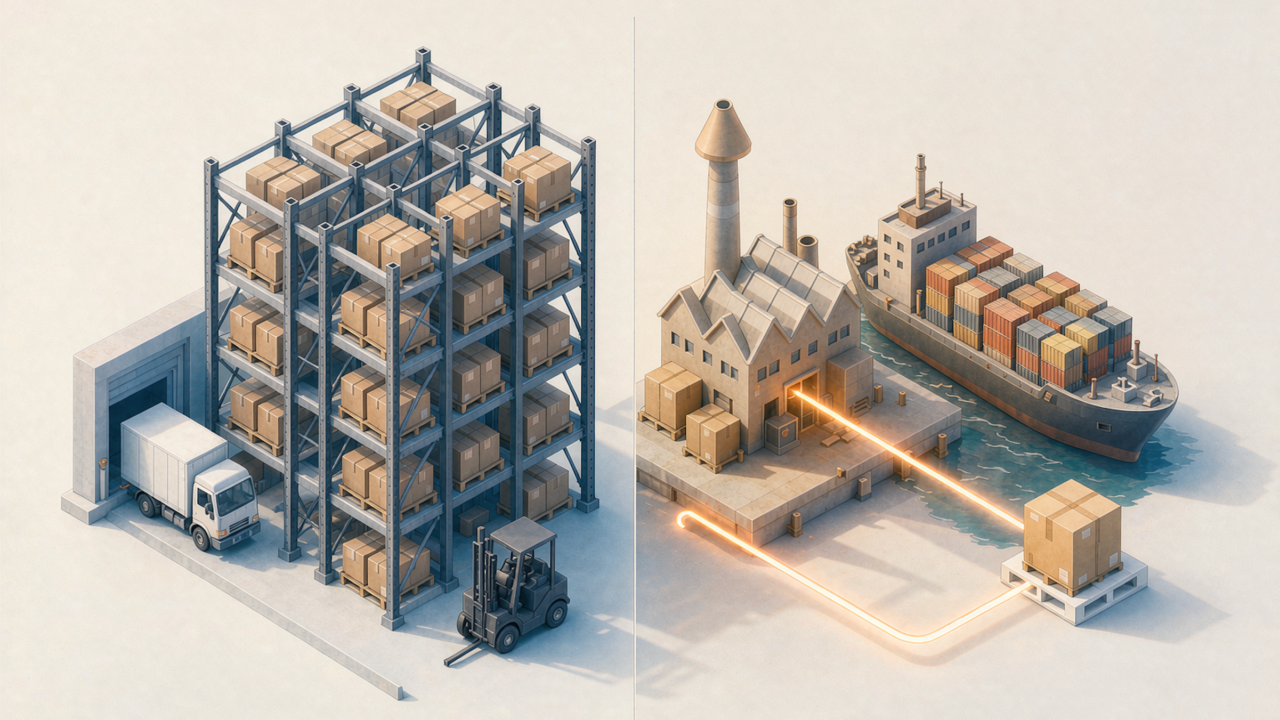
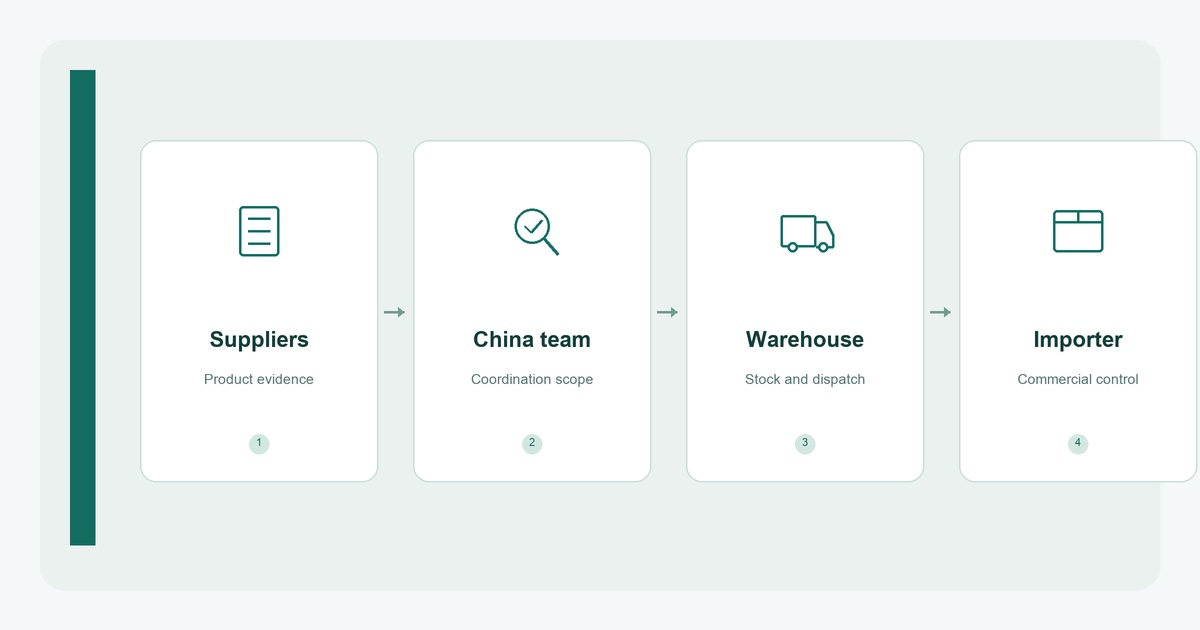
A 3PL and an integrated sourcing partner can both help with fulfillment, but they solve different operating problems. The right choice depends on whether your business already controls supplier communication and inbound procurement or needs one partner to connect sourcing, QC, warehousing, and international delivery.
Key Takeaways
- Compare the scope and handoffs, not only the warehouse or shipping price.
- Choose a 3PL when you need focused logistics execution; choose integration when fragmented sourcing is the bigger problem.
- Write a responsibility matrix before the pilot starts.
Compare the operating models
A traditional 3PL usually starts when inventory arrives at its facility. An integrated sourcing partner may enter earlier, helping with supplier discovery, purchasing, inspection, receiving, consolidation, and shipment planning. Neither model is automatically better. The question is where your current process breaks and who should own the missing control.
| Area | What to examine | Evidence or decision output |
|---|---|---|
| 3PL | Focused on receiving, storage, pick, pack, and dispatch after inventory enters the network | Good for mature procurement teams with clear inbound control |
| Sourcing agent | Focused on supplier communication and purchasing, with variable logistics scope | Good for selected China-side procurement tasks |
| Integrated partner | Connects supplier coordination, QC, warehouse, consolidation, and shipping | Good when the importer needs one connected workflow |
Make the handoffs explicit
- Map your current supplier-to-delivery process and mark every failure point.
- Ask each provider to state what it owns and what it does not own.
- Run one controlled order with agreed documents, updates, and exception rules.
- Review total coordination cost, not just the provider invoice.
Choosing for Spain and Japan
This article uses Spain and Japan as the destination-market lenses. For Spain, include the relationship between China operations, Spain inventory, and local fulfillment. For Japan, evaluate the accuracy and discipline of supplier-to-destination communication. In both markets, destination compliance responsibility must be explicit.
Locate the problem before choosing a partner model
Write down the last several operational failures and the point at which each started. A picking error after accepted inventory reaches a warehouse is different from a supplier shipping the wrong product version. The first may need stronger warehouse execution; the second needs purchasing, specification, and quality controls before receipt. One provider label cannot tell you which capability will address the actual cause.
Map your existing internal ownership as well. If the business already has a capable purchasing team and approved suppliers, it may mainly need storage and fulfillment. If important decisions are scattered across translators, suppliers, inspectors, and freight providers, coordinated China-side execution may be more relevant. Avoid outsourcing a decision your own team has not defined.
A responsibility matrix for the operating model
- Supplier selection: identify who develops the brief, checks capability, compares proposals, and approves the commercial choice.
- Product release: name the person who approves samples and accepts inspection evidence. Separate coordination from final approval authority.
- Inbound stock: identify who books receipts, resolves count differences, labels variants, and records inspection-held inventory.
- Dispatch: define who releases orders, chooses approved routes, packs goods, and preserves carrier handoff evidence.
- Destination: identify the importer, customs representative, receiving warehouse, and the company responsible for local distribution.
- Exceptions: give every claim a lead coordinator, evidence owner, commercial decision owner, and next action.
Ask both candidates to handle the same scenario
Use a hypothetical order from two suppliers, with one product needing packaging correction before consolidation. Ask the 3PL and integrated partner what work they would perform, what they would refer back to your team, and what they would charge separately. Request sample reports and escalation records. Compare the complete handoff rather than the provider’s broad service list.
A 3PL might receive and hold the goods while your purchasing team negotiates the correction. An integrated coordinator might manage that supplier discussion and arrange repacking, subject to the agreed scope. Neither answer determines quality by itself. Check whether the proposed division of work leaves your team with unresolved decisions or duplicate instructions.
Compare the costs the business will actually incur
Use the same product quantities, warehouse workload, destination, and exception assumptions. Separate recurring provider fees from setup charges, pass-through expenses, and your internal coordination effort. Show unknown amounts explicitly. A low storage rate can be outweighed by repeated extra handling, while a larger coordination fee may include work that your employees currently perform.
Do not invent an internal labor saving to justify the preferred model. Estimate hours from your own order records or a pilot. Include the time spent clarifying suppliers, inspecting documents, investigating discrepancies, and resolving delivery problems. Keep fixed staffing costs distinct from expenditure that would actually change after outsourcing.
Evaluate destination handoffs and exit arrangements
For a Spain operation, test how the China partner provides information to the Spanish receiving and distribution team. For Japan, test the actual product and document requirements supplied by the importer. Require a shared version of the product record and a named contact for unresolved details. This is a coordination assessment, not a promise that the provider replaces destination responsibilities.
Agree how inventory, purchase records, supplier correspondence, inspection evidence, and open claims will be transferred if the relationship ends. Run a limited pilot and assess the resulting evidence before moving the full operation. The suitable model is the one that closes your current responsibility gaps while preserving clear commercial control.
Use one evidence owner for an integrated claim
If a defect discovered at destination involves several providers, agree who assembles the inspection, packing, transport, and receiving records. The lead coordinator should identify the unresolved question and next action without assuming responsibility for every company contract. Preserve original evidence and document the commercial remedy separately. This makes integrated coordination useful while keeping the rights and responsibilities of each participating party visible.
How Fishgoo Helps
For this workflow, Fishgoo can help coordinate supplier communication, inspection, warehousing and logistics coordination, subject to the confirmed product and destination scope. Its service overview describes China-side sourcing, quality, warehouse and shipping support. Bring the approved product brief, quantity, supplier status, destination and open issues to the discussion. Confirm deliverables, fees, reporting and approval rights before work begins. The buyer retains commercial decisions and destination-market responsibilities; no automatic channel integration or guaranteed outcome is assumed.
Discuss your China sourcing and fulfillment workflow with Fishgoo.
FAQ
Is an integrated partner always more expensive?
Not necessarily. Compare the full cost of internal coordination, quality failures, delays, and multiple vendor handoffs against the provider’s complete scope.
Can a company use a 3PL and a sourcing partner together?
Yes. Define the system of record, handoff documents, inventory ownership, and escalation path so the combination does not create duplicate responsibility.
What should the pilot measure?
Measure order accuracy, inspection handling, inventory accuracy, document completeness, on-time release, landed-cost variance, and exception response.
See Also
China Supplier RFQ Template: What to Include Before Requesting Quotes
MOQ Negotiation in China: How Importers Build a Viable First Order
Private Label Manufacturing in China: Governance for Growing Brands
China Product Sampling for Commercial Buyers: From Brief to Approval
How Shopify Brands Can Build a China Supply Chain for Spain and Japan