

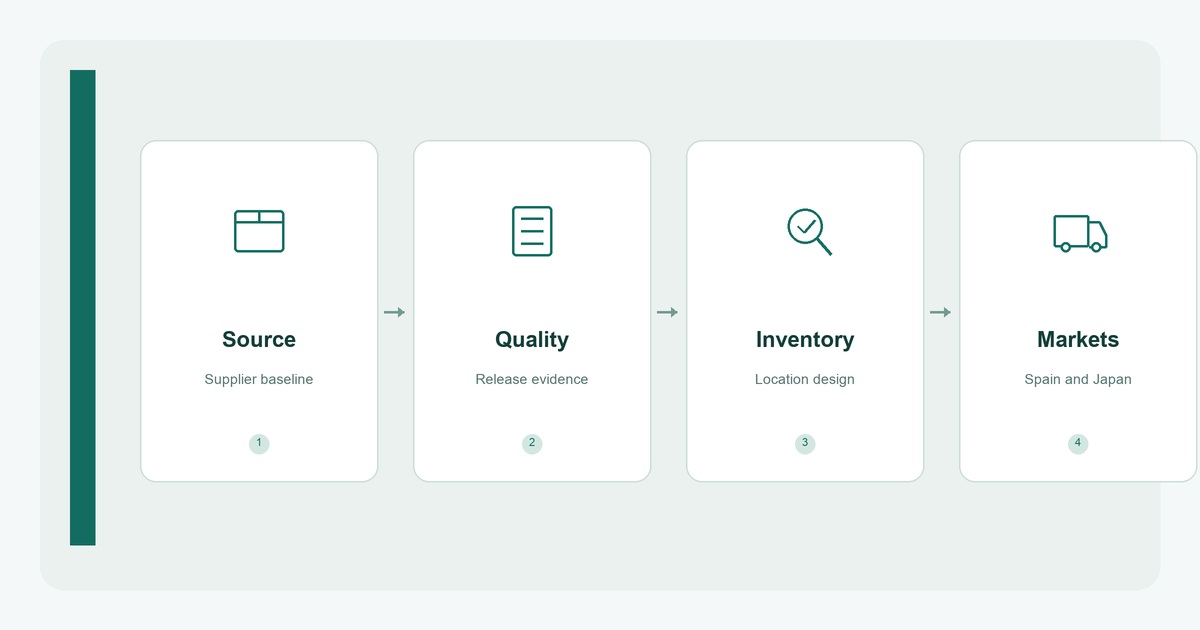
A Shopify storefront does not create a supply chain by itself. As a brand grows in Spain or Japan, the operating system behind the storefront must connect demand, China sourcing, supplier quality, inventory, fulfillment, and customer delivery promises.
Key Takeaways
- Treat Shopify as a sales channel connected to a wider supply chain.
- Define stock, order, QC, and exception ownership before adding volume or markets.
- Use channel data to improve supplier and replenishment decisions.
Build the supply chain around the commercial promise
Start with the promise the brand makes: available stock, delivery window, product consistency, packaging, and return handling. Then work backward to the supplier, specification, approval, warehouse, route, and local fulfillment design. A channel integration is useful only when the underlying inventory and exception data are reliable.
| Area | What to examine | Evidence or decision output |
|---|---|---|
| Demand | Which SKU, market, channel, and campaign creates the order signal? | Forecast and reorder rule |
| Supply | Which supplier, specification, MOQ, lead time, and QC gate supports the SKU? | Approved sourcing record |
| Fulfillment | Where is stock held and how are order, pick, pack, ship, and exception states updated? | End-to-end order status |
Scale in operating stages
- Stabilize the product specification and supplier record.
- Connect inventory and order status to the fulfillment workflow.
- Set inspection, packaging, release, and exception rules.
- Review delivery, stockout, return, and landed-cost data before expanding the market.
Shopify brands serving Spain and Japan
This article uses Spain and Japan as the destination-market lenses. A Spain-focused brand may combine China sourcing with Spain-based inventory or distribution. A Japan-focused brand may prioritize tighter product information and supplier communication. Keep one common operating definition while adjusting market-specific delivery and compliance requirements.
Design the operating model before configuring the store
Group products by demand stability, specification complexity, and acceptable replenishment time. A repeat-selling core SKU may justify inventory closer to its customers, while a product under commercial validation may remain in a limited China stock program. Compare those choices using actual supplier performance, storage and handling charges, cash exposure, and the delivery promise the brand can support.
Map the physical stock locations separately from the companies involved. Identify where goods are accepted, where inspection holds are recorded, where orders are released, and who updates the sales system. A purchasing coordinator can connect these tasks without owning the destination warehouse. Keep that distinction visible in the operating agreement.
Use locations and stock states deliberately
Shopify’s official locations guidance explains how locations support inventory tracking and fulfillment assignment. Model the locations used by your actual operation and confirm which are eligible to fulfill each product. The existence of a location does not by itself prove that the associated stock is ready to ship.
Shopify also distinguishes inventory states such as available, committed, unavailable, and incoming. Map warehouse evidence to those states consistently. Test the mapping before enabling a new route. Your technical team should verify the current app behavior rather than assuming every fulfillment provider synchronizes the same fields.
A supply-chain design worksheet
- Product group: record the approved supplier, specification, packaging, demand pattern, and market-specific variants.
- Stock model: identify China and destination locations, inspection status, replenishment frequency, and the reason for holding inventory there.
- Decision rights: identify who approves supplier changes, stock transfers, route changes, and deviations from the product promise.
- Information flow: list the source of stock quantities, update timing, reconciliation method, and escalation when systems disagree.
- Economics: compare product, quality, warehouse, transportation, destination, and internal coordination costs using the same scope.
Test the design with two market scenarios
Consider a hypothetical brand with a stable Spanish wholesale customer and a smaller Japan retail program. The brand could evaluate periodic Spain replenishment and a separate Japan supply schedule. This does not require either market to use the same stock depth or shipping route. Both can still share the same approved product baseline and China-side purchasing controls.
Ask what happens if the next supplier lot fails inspection. Identify which orders can use existing accepted stock, which market allocations must change, and who informs the channel team. Review whether the destination operation can see the hold. A design that relies on every receipt passing inspection has no useful plan for a foreseeable interruption.
Introduce the model through a limited product group
Choose a product group with clear records and enough repeat demand to evaluate the process. Confirm product identifiers, run a stock reconciliation, and test one replenishment cycle before expanding. Separate setup work from recurring work when reviewing cost. This helps finance understand whether initial effort will continue at the same level.
Review the design after the pilot using accepted-stock availability, replenishment variance, inventory discrepancies, exception workload, and cash tied in stock. The order-fulfillment procedure should then translate the accepted model into daily release and dispatch steps. Keeping design decisions separate from daily execution makes each easier to change without losing responsibility for the other.
Give the design a clear change process
When the brand introduces a new SKU, route, or stock location, require an impact review covering purchasing, quality, inventory data, packing, and destination receipt. Confirm that the new product identifiers can be reconciled across the actual systems. Record the effective date and affected orders. A controlled change prevents a small catalog addition from bypassing the operating controls established during the original pilot.
How Fishgoo Helps
For this workflow, Fishgoo can help coordinate product sourcing, supplier coordination, quality checks and shipment planning, subject to the confirmed product and destination scope. Its service overview describes China-side sourcing, quality, warehouse and shipping support. Bring the approved product brief, quantity, supplier status, destination and open issues to the discussion. Confirm deliverables, fees, reporting and approval rights before work begins. The buyer retains commercial decisions and destination-market responsibilities; no automatic channel integration or guaranteed outcome is assumed.
Discuss your China sourcing and fulfillment workflow with Fishgoo.
FAQ
Does Shopify solve sourcing and fulfillment?
No. Shopify manages the storefront and order environment. Sourcing, QC, inventory, freight, customs, and fulfillment still require separate processes or a connected partner.
When should a Shopify brand hold inventory?
Consider holding stock when demand is repeatable, delivery promises matter, or the cost of stockouts exceeds the cost of inventory. Use a forecast and cash-flow model.
What is the first integration to improve?
Start with SKU identity, available inventory, order status, and exception visibility. These are the records that connect sales promises to operations.
See Also
Shopify Order Fulfillment from China for Multi-Market Operations
TikTok Shop Supply Chain Governance for Brands
Short-Video Commerce Supply Chains: Operational Requirements for Spain and Japan
Seasonal Inventory Planning for Importers Serving Spain and Japan
How to Select a China Fulfillment Center for B2B and Cross-Border Operations