

Shopify fulfillment from China is an operations problem behind the storefront. A growing brand needs reliable SKU data, inventory visibility, order routing, QC, packing, shipping, returns, and exception handling so the store’s delivery promise matches what the supply chain can actually deliver.
Key Takeaways
- Connect Shopify orders to a controlled inventory and fulfillment workflow.
- Define the China warehouse, carrier, QC, and exception responsibilities.
- Use channel data to improve replenishment and market decisions.
The operating chain behind a Shopify order
The order path should be visible from sale to release: order received, inventory reserved, item picked, packing checked, shipment booked, tracking updated, and exception resolved. If the brand sources directly from several suppliers, add the supplier, receiving, inspection, and consolidation stages before fulfillment.
| Area | What to examine | Evidence or decision output |
|---|---|---|
| Order data | Are SKU, quantity, address, delivery promise, and channel status consistent? | Order and inventory record |
| Warehouse | Can the China-side team receive, inspect, store, pick, pack, and release accurately? | Warehouse workflow |
| Customer promise | Does the selected route and stock plan support the promised delivery and returns process? | Service-level rule |
Set up fulfillment in stages
- Clean SKU, package, and inventory data before integration.
- Define order routing and exception states.
- Test receiving, QC, packing, tracking, and return instructions.
- Review order accuracy, stockouts, delivery, damage, and cost by market.
Shopify operations in Spain and Japan
This article uses Spain and Japan as the destination-market lenses. A Spain operation may use China inventory for testing and Spain stock for faster local fulfillment. A Japan operation may need more careful information and delivery coordination. Keep channel data common while adapting the market handoff.
Turn the supply-chain design into an order procedure
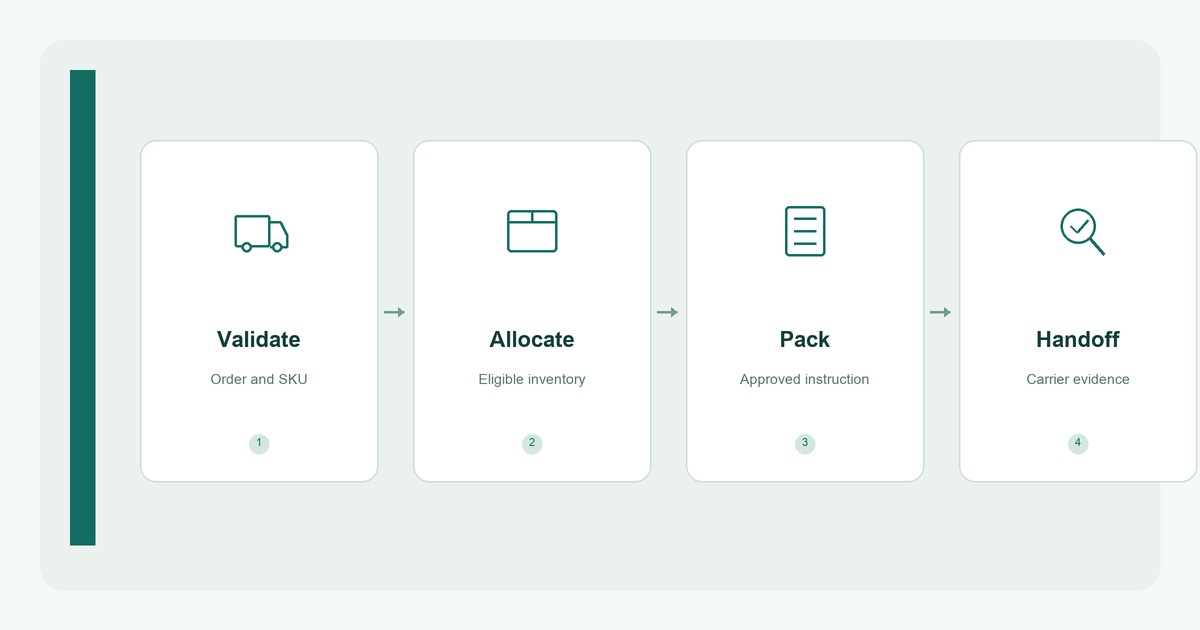
Start with the approved product records, warehouse locations, inventory definitions, and shipping routes. Map the daily order sequence from receipt to validation, stock allocation, release, picking, packing, and carrier handoff. Identify the evidence created at each step. Keep configuration decisions separate from the person who performs the daily checks.
Shopify’s official fulfillment guidance describes handling orders and tracking information. Have the technical and operations teams confirm the workflow used by the actual fulfillment app or provider. A visible fulfillment status must correspond to the agreed physical event, rather than simply a message being sent between systems.
A daily release checklist
- Order identity: confirm the channel order number, market, recipient details, SKU, variant, quantity, and approved packing instruction.
- Stock eligibility: check usable quantities at the selected location and exclude damaged, held, or already allocated units.
- Exceptions: identify address changes, unsupported routes, substitutions, split orders, and missing information before releasing work.
- Packing: verify the product version, inserts, labels, carton or parcel configuration, and evidence required by the brand.
- Dispatch: connect the package identifier, carrier handoff, tracking record, and order status. Assign unresolved handoffs to an owner.
Test split orders and inventory discrepancies
Use a hypothetical order containing two products, only one of which is accepted and available. Apply the brand’s rule for holding the order, splitting it, or contacting the customer. Record the extra shipment cost and how the order status explains partial completion. Do not let the warehouse invent a substitution to clear the queue.
If the system shows stock that the picker cannot find, stop the affected release and investigate the location, recent transactions, and reserved quantities. Preserve the discrepancy record and correct the stock through the agreed process. A manual promise that inventory will arrive tomorrow is not equivalent to a counted unit ready for packing.
Handle changes after release deliberately
Define the point at which an address or quantity change can still be accepted. Give the warehouse a cancellation or change request that identifies the original order and its current state. Require acknowledgement before the channel team tells the customer the change succeeded. A message sent after carrier handoff may be too late to alter the physical shipment.
For Spain and Japan orders, apply the actual address, product information, packing, and delivery requirements agreed with the destination operation. Keep the market instructions in the product or route record where the fulfillment team can find them. Avoid relying on informal knowledge held by a single employee to distinguish two otherwise similar orders.
Reconcile orders against physical dispatch evidence
Review orders that have stopped progressing and identify the next action. Separate label creation, packed status, carrier acceptance, and delivery evidence in the operational record. Investigate why a supposedly fulfilled order lacks the required handoff record. The brand’s chosen status mapping should make such discrepancies visible rather than treating every tracking number as proof of movement.
At the review interval chosen by the business, compare inventory adjustments, released orders, packed quantities, dispatch records, cancellations, and returns. State the denominator and exclusions when reporting accuracy or timeliness. Use recurring exceptions to improve SKU mapping, release rules, packing instructions, and provider coordination. This article’s deliverable is a daily execution procedure, rather than a new supply-chain design.
Define returned-stock re-entry
Keep returned goods unavailable until the agreed check determines their condition and disposition. Connect the returned unit to its original SKU and order where possible. Record whether it can be resold, repacked, repaired, held for a claim, or removed under the business process. Do not automatically increase available inventory when the warehouse receives a return; physical receipt and saleable acceptance are different events.
How Fishgoo Helps
For this workflow, Fishgoo can help coordinate warehouse packing, inventory checks and carrier handoff coordination, subject to the confirmed product and destination scope. Its service overview describes China-side sourcing, quality, warehouse and shipping support. Bring the approved product brief, quantity, supplier status, destination and open issues to the discussion. Confirm deliverables, fees, reporting and approval rights before work begins. The buyer retains commercial decisions and destination-market responsibilities; no automatic channel integration or guaranteed outcome is assumed.
Discuss your China sourcing and fulfillment workflow with Fishgoo.
FAQ
Can Shopify automatically handle China fulfillment?
Shopify can provide order and storefront data, but sourcing, QC, inventory, shipping, customs, and returns still need an operating process or connected partner.
What happens when the store sells an out-of-stock SKU?
Use inventory controls, safety stock, backorder rules, and an exception workflow so the customer promise does not rely on an inaccurate stock number.
What should be tested before launch?
Test SKU mapping, inventory reservation, order routing, packing, tracking, address exceptions, cancellation, and return handling.
See Also
TikTok Shop Supply Chain Governance for Brands
How Shopify Brands Can Build a China Supply Chain for Spain and Japan
How to Select a China Fulfillment Center for B2B and Cross-Border Operations
Seasonal Inventory Planning for Importers Serving Spain and Japan
Short-Video Commerce Supply Chains: Operational Requirements for Spain and Japan