

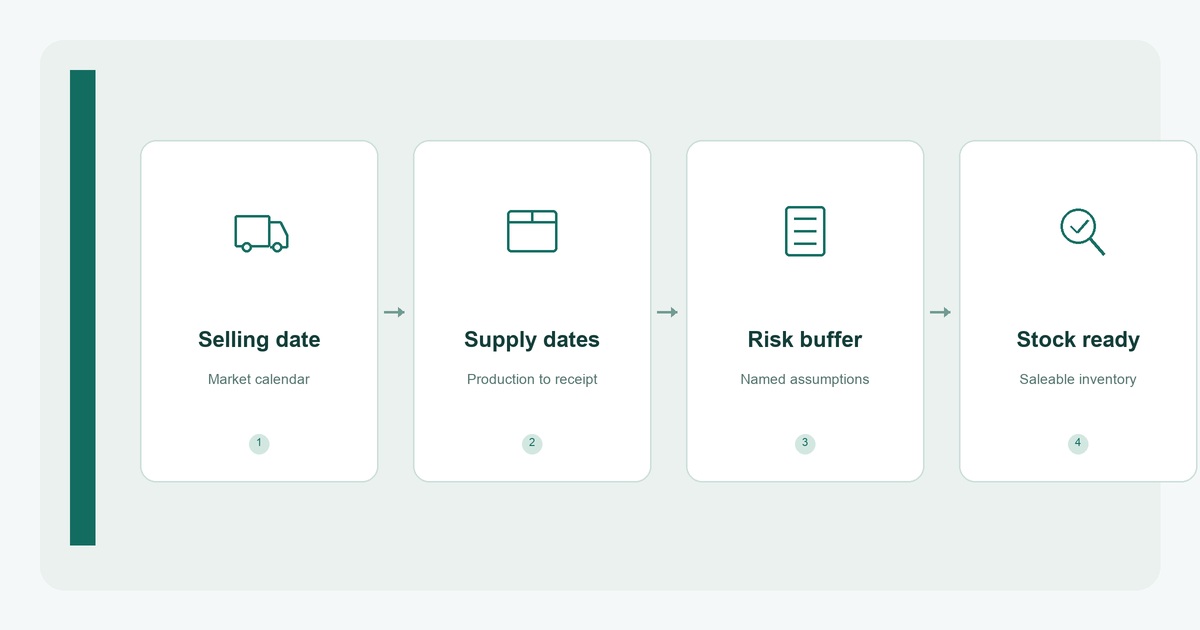
Seasonal inventory planning is a cross-functional decision involving demand, production, shipping, warehouse capacity, cash flow, and customer delivery. Importers serving Spain and Japan should plan backward from the commercial date rather than ordering when sales are already accelerating.
Key Takeaways
- Build a market and SKU calendar before placing the seasonal order.
- Add supplier, inspection, freight, customs, and warehouse lead time to the plan.
- Set an exit plan for excess stock before the season begins.
Plan backward from the required stock date
Start with the date the inventory must be available for sale or distribution. Work backward through local receiving, customs, international freight, warehouse processing, pre-shipment inspection, production, sampling, and supplier confirmation. Add a defined buffer for the risks that matter most to the product and route.
| Area | What to examine | Evidence or decision output |
|---|---|---|
| Demand | Which SKUs, markets, channels, and campaigns are seasonal? | Base and scenario forecast |
| Supply | What are production, approval, QC, freight, customs, and receiving lead times? | Backward planning calendar |
| Exit | What happens if demand is lower or the season moves? | Markdown, transfer, or alternate-market plan |
Build a seasonal control cycle
- Freeze forecast assumptions and the order approval date.
- Confirm capacity, materials, packaging, and inspection windows with suppliers.
- Book the route early enough to protect the receiving date.
- Review sales, inventory, and route performance weekly during the season.
Spain and Japan planning differences
This article uses Spain and Japan as the destination-market lenses. Use separate calendars for Spain and Japan when holidays, campaigns, channel demand, and receiving constraints differ. Keep the supplier and QC process shared where possible, but do not assume that one market’s seasonal buffer works for the other.
Start with a stock-availability calendar
Ask the commercial team for the date accepted inventory must be available at the selling or distribution location. Keep that date separate from the campaign launch, vessel arrival, or warehouse unloading date. Goods that have arrived but remain on a receiving or inspection hold cannot support the same promise as saleable stock.
Work backward through receiving, destination processing, transport, consolidation, inspection, production, sample approval, and supplier confirmation. Use dates supplied by the responsible parties and note whether they are firm or estimated. A seasonal plan becomes useful when it shows where the schedule has little room for a correction, rather than only displaying the final deadline.
A seasonal readiness worksheet
- Demand window: record the market, product group, required availability date, expected selling period, and confirmed commercial commitments.
- Supply milestones: list the latest approved sample, material commitment, production completion, inspection, and cargo-ready dates.
- Capacity: confirm the supplier, inspector, packing facility, carrier, and receiving warehouse can support the proposed quantities and dates.
- Buffer: identify the uncertainty each allowance covers. Avoid adding unexplained days at every stage without checking the total.
- Contingency: state the shortage response, alternative route, spending authority, and point at which promotion or customer commitments must change.
Test a late-production scenario before it happens
Suppose an illustrative seasonal order is ready later than planned. Compare the remaining time with inspection, booking, transport, and receiving requirements. Split the demand into firm commitments, expected baseline sales, and optional campaign volume. The commercial team can then decide whether a partial shipment protects the most important commitments without rushing the entire order.
Check whether the urgent portion can be identified and inspected independently. Confirm the cost of additional handling, documents, transport, and destination receiving. Treat the split as an approved exception with its own rationale. Do not cancel quality controls simply because the commercial calendar has become tight.
Keep Spain and Japan assumptions separate
Build market-specific calendars from the customers, promotional plans, receiving teams, and routes actually involved. Do not copy a Spain demand peak into the Japan forecast without evidence. Shared suppliers may still face different packing versions, shipment dates, or commercial commitments. Aggregate production only after the product and timing assumptions have been checked.
Have local teams confirm their operating closures and appointment constraints for the relevant period. Record the source and confirmation date. Calendar assumptions can change, so a previous year’s plan is a starting reference rather than an authoritative schedule. Explain changes to the China-side coordinator before booking production and freight.
Set rules for both shortage and surplus
Define what triggers a smaller campaign, an additional order, a stock transfer, or an alternative product offer. Identify who decides and how customers are informed. For seasonal surplus, examine the next viable selling window, storage cost, product revision risk, and cash tied up. A late purchase can solve a shortage while creating stock that arrives after its useful season.
After the selling period, reconcile forecast demand, actual sales, accepted receipts, remaining stock, expedited costs, and cancelled commitments. Attribute problems to the stage where they began. Use those findings to revise the next seasonal calendar and purchasing assumptions. The objective is a repeatable decision process, not a blanket instruction to buy more stock earlier.
Make the final purchasing cutoff visible
Set the date after which additional stock cannot reasonably support the seasonal selling window under the approved route. Review late demand requests against that cutoff. If the business still chooses to buy, record the alternative selling plan and cash exposure. This distinguishes a deliberate inventory investment from a rushed response based on a launch date the supply chain can no longer meet.
How Fishgoo Helps
For this workflow, Fishgoo can help coordinate supplier readiness, inspection booking and seasonal shipment planning, subject to the confirmed product and destination scope. Its service overview describes China-side sourcing, quality, warehouse and shipping support. Bring the approved product brief, quantity, supplier status, destination and open issues to the discussion. Confirm deliverables, fees, reporting and approval rights before work begins. The buyer retains commercial decisions and destination-market responsibilities; no automatic channel integration or guaranteed outcome is assumed.
Discuss your China sourcing and fulfillment workflow with Fishgoo.
FAQ
How early should a seasonal order be placed?
Work backward from the required receiving date using the full production-to-delivery timeline. The right lead time depends on product, supplier, route, and season.
What is the best way to avoid excess stock?
Use scenarios, staged purchasing, smaller initial commitments where possible, and an exit plan for stock that does not sell as expected.
Can a local warehouse solve seasonal risk?
A local warehouse can improve delivery once stock is available, but it does not solve forecasting, production, or import timing by itself.
See Also
How Shopify Brands Can Build a China Supply Chain for Spain and Japan
Demand Forecasting for Importers: Linking Sales Plans to China Replenishment
Short-Video Commerce Supply Chains: Operational Requirements for Spain and Japan
Shopify Order Fulfillment from China for Multi-Market Operations