

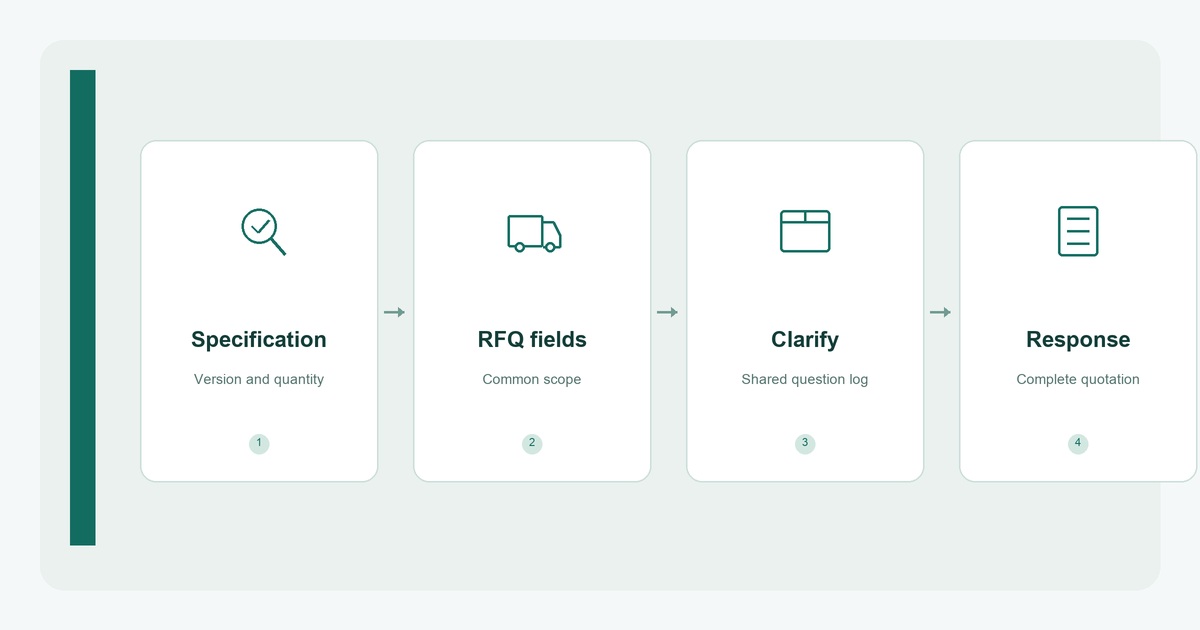
A China supplier RFQ should define what the buyer wants suppliers to quote before prices are compared. Procurement teams need a common product specification, quantity, packaging, quality requirements, timing, and delivery scope. Use the field template below to obtain complete responses and a traceable clarification record.
Key Takeaways
- Normalize the brief before comparing supplier replies.
- Score commercial value and execution risk alongside price.
- Keep supplier assumptions and unanswered questions visible in the decision record.
Prepare a comparable RFQ response
Put every supplier on the same sheet. Separate product price, tooling, sample, packaging, China-side handling, freight, duties, inspection, and destination delivery. Then record the conditions behind each number. A supplier with a higher unit price may still offer a lower total landed cost or a safer production plan.
| Area | What to examine | Evidence or decision output |
|---|---|---|
| Commercial | Price, currency, MOQ, price breaks, tooling, sample, and payment terms | Comparable cost view |
| Execution | Lead time start point, capacity, QC, packaging, and change handling | Delivery and quality risk score |
| Destination | Incoterm, freight, document scope, customs handoff, and delivery point | Landed-cost and responsibility view |
Make the inquiry auditable
- Set criteria and weights before choosing the preferred supplier.
- Score evidence and mark missing information as a risk.
- Ask the preferred supplier to confirm the final version in writing.
- Link the decision to the purchase order, specification, sample, and inspection plan.
RFQ destination annexes for Spain and Japan
This article uses Spain and Japan as the destination-market lenses. Spanish importers should include warehouse destination, local distribution, and route assumptions. Japanese importers should include specification and document accuracy in the risk score. Avoid using one market’s quote assumptions for the other.
Define the requested quotation before inviting suppliers
An RFQ is a request for suppliers to price a defined requirement. It should help a supplier identify the exact product, quantity, quality expectations, packaging, and delivery scope. Write the request before collecting offers so every candidate answers the same questions. Quote comparison comes later; this template focuses on preventing incomplete or incompatible responses.
Give the RFQ an identifier, issue date, product revision, response deadline, and buyer contact. State whether the project is supplier screening, a commercial pilot, or recurring replenishment. If volumes are forecasts, label them as forecasts. Avoid presenting an optimistic annual quantity as a purchase commitment the business has not approved.
Copyable RFQ field template
| Field | Buyer input | Supplier response required |
|---|---|---|
| Product identity | SKU, drawing, specification revision, intended use, approved variants | Exact quoted version and any proposed deviation |
| Materials and function | Required materials, dimensions, tolerances and test methods selected by the product owner | Capability confirmation and evidence available |
| Quantities | Pilot quantity and separately identified forecast quantities | MOQ, price tiers, capacity assumptions and setup constraints |
| Packaging | Unit pack, carton count, artwork version, identification and destination variants | Included pack configuration and separately priced alternatives |
| Samples and assets | Sample purpose, approval reference, tooling and ownership questions | Sample fee, development steps, asset custody and production differences |
| Quality and documents | Inspection requirements and product records confirmed with the destination reviewer | Acceptance of checks, available documents and unresolved requirements |
| Timing and delivery | Required availability date, delivery location and requested commercial scope | Production milestones, quoted term, named place and exclusions |
| Price and payment | Currency, required cost breakdown and proposed payment milestones | Unit price, one-time charges, validity period and payment conditions |
Show suppliers how to answer open requirements
Where a requirement is unresolved, request an explicitly labeled option instead of leaving the supplier to choose silently. For example, if two packaging structures are under consideration, ask for separate costs and production implications. Require the supplier to state the exact structure included in its main proposal. This gives the buyer a choice rather than a misleading average price.
Ask suppliers to identify exceptions beside the relevant field. “Complies” should be supported by the requested drawing, sample, explanation, or other evidence where material to the decision. Keep unanswered fields visible. An empty response is not a zero cost, acceptance of a requirement, or proof that the supplier can perform the work.
Run a single clarification process
Collect supplier questions in one log with the question, affected requirement, buyer answer, revision, and recipients. Share material changes with all candidates that are still participating. If the product owner changes the material, issue the revised specification and confirm whether previous prices remain valid. A comparable response starts with a comparable request.
For a Spain shipment and a Japan shipment, attach separately confirmed destination instructions. Keep shared product requirements in the common specification and use a destination annex for actual differences. The buyer’s relevant specialists must confirm product-specific documentation. Do not ask the supplier to infer destination requirements from the country name alone.
Check completeness before comparing prices
Review whether each response identifies the product version, quantity, price basis, packaging, quality checks, timeline, payment conditions, and excluded activities. Return incomplete responses for clarification before scoring them. Record whether a supplier refused a mandatory condition or simply needs more information. Those situations require different follow-up.
Archive the final RFQ and response together with the clarification history. The subsequent quotation comparison should use that record as its baseline. This keeps the RFQ article distinct from a supplier-ranking guide: its deliverable is a complete, traceable inquiry that suppliers can answer and procurement can later evaluate.
Prevent the template from becoming an empty form
Remove fields that do not apply and add product-specific requirements that do. Explain unfamiliar terms or attach drawings so the supplier can answer accurately. Before issuing the RFQ, ask a colleague unfamiliar with the project to identify the quoted product and delivery scope. If that colleague must guess, a supplier will probably have the same problem. Resolve those gaps before the response deadline begins.
How Fishgoo Helps
For this workflow, Fishgoo can help coordinate supplier inquiry coordination and clarification of technical and commercial responses, subject to the confirmed product and destination scope. Its service overview describes China-side sourcing, quality, warehouse and shipping support. Bring the approved product brief, quantity, supplier status, destination and open issues to the discussion. Confirm deliverables, fees, reporting and approval rights before work begins. The buyer retains commercial decisions and destination-market responsibilities; no automatic channel integration or guaranteed outcome is assumed.
Discuss your China sourcing and fulfillment workflow with Fishgoo.
FAQ
Should the lowest quote win?
No. The selected supplier should meet the commercial, quality, delivery, communication, and destination requirements at an acceptable total cost.
What if suppliers quote different Incoterms?
Normalize the responsibility and cost scope before comparison. If the scope cannot be normalized, keep the quotes in separate scenarios.
How can a sourcing partner help?
A sourcing partner can collect comparable replies, clarify supplier assumptions, support negotiation, and coordinate the selected supplier with QC and fulfillment.
See Also
China Product Sampling for Commercial Buyers: From Brief to Approval
3PL vs Integrated Sourcing Partner: Which Operating Model Fits Your Business?
Private Label Manufacturing in China: Governance for Growing Brands
MOQ Negotiation in China: How Importers Build a Viable First Order
China Supplier Due Diligence: A Verification Checklist for Importers