
Demand forecasting becomes a procurement issue when sales plans determine how much stock must be ordered, produced, inspected, and moved from China. Importers and brands need a forecast that connects demand assumptions with production lead time, cash flow, warehouse capacity, and delivery commitments.
Key Takeaways
- Forecast by SKU, market, and replenishment cycle instead of using one total sales number.
- Include production, QC, freight, customs, and warehouse lead time in the reorder decision.
- Review forecast error and stockout causes before changing supplier quantities.
Connect demand to supply decisions
A useful forecast answers three questions: how much may sell, when the stock must be available, and how much uncertainty the business can absorb. Separate baseline demand, planned promotions, seasonal effects, and new-product assumptions. Then compare the result with supplier MOQ, production capacity, inspection timing, route, and warehouse receiving capacity.
| Area | What to examine | Evidence or decision output |
|---|---|---|
| Demand input | What sales history, channel plan, market mix, and promotion assumptions support the forecast? | SKU-level forecast with assumptions |
| Supply input | What production, approval, inspection, freight, and customs lead times apply? | End-to-end replenishment calendar |
| Risk buffer | How much uncertainty can the business afford in stockout, overstock, and cash tied in inventory? | Scenario and safety-stock rule |
Turn a forecast into a replenishment plan
- Create a base, high, and low scenario for each important SKU.
- Map each scenario to supplier MOQ, production lead time, and shipping route.
- Set reorder points and approval owners before inventory becomes urgent.
- Review actual sales, lead time, stockouts, and excess stock after every cycle.
Spain and Japan demand planning
This article uses Spain and Japan as the destination-market lenses. Use separate market assumptions for Spain and Japan when demand patterns, campaigns, channel mix, or delivery promises differ. A shared supplier does not mean both markets should use the same reorder point or safety-stock rule.
Build the forecast from usable demand records
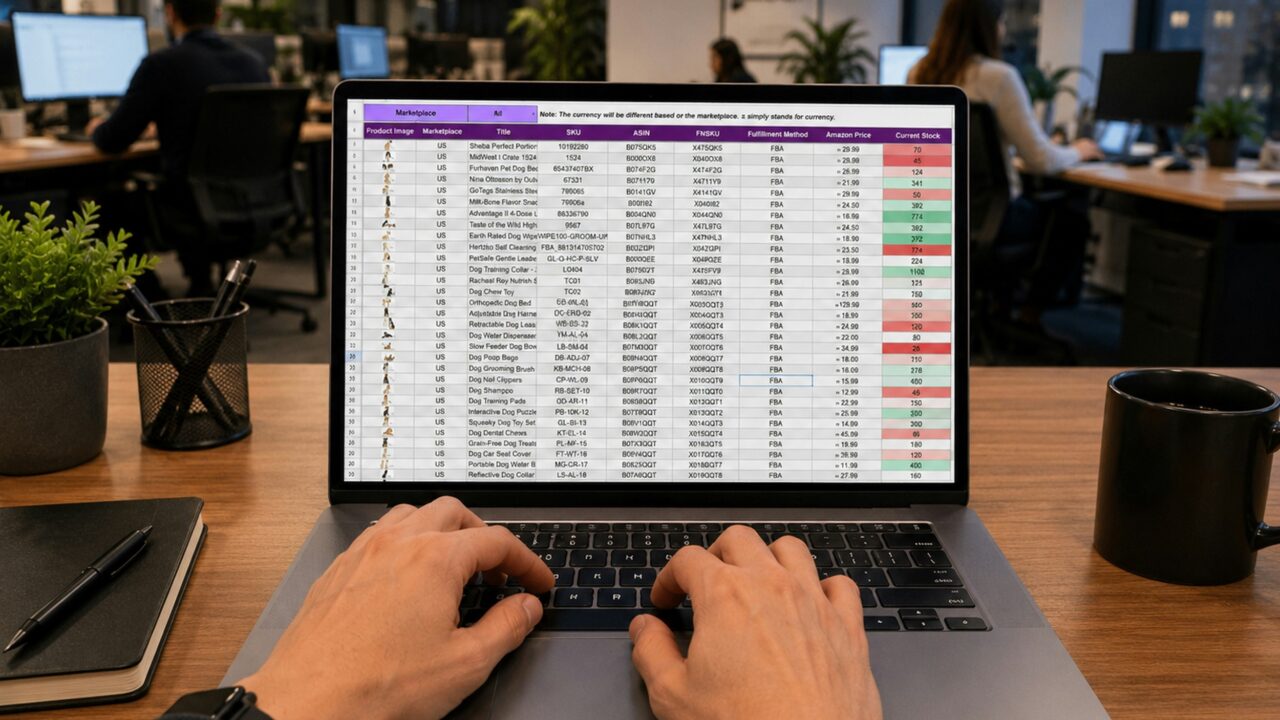
Start with sales or consumption by SKU, market, and period. Keep returns, cancellations, unusual promotions, and days without available stock visible. Observed sales during a stockout may understate demand, while a one-off campaign may overstate repeat demand. Annotate these events before copying historical quantities into a purchasing plan.
Separate firm customer commitments from anticipated sales. A distributor’s confirmed purchase order and a brand’s promotional target have different evidence behind them. Give each forecast assumption an owner and a review date. This lets procurement ask what changed when the replenishment quantity moves, instead of receiving an unexplained replacement spreadsheet.
Translate demand into an inventory position
Use accepted stock, allocations, confirmed incoming quantities, and open customer commitments to describe the current position. Do not count a supplier’s informal promise as inspected incoming inventory. Record the event and expected date at which each incoming lot becomes usable. A single total can hide stock that is physically present but unavailable for release.
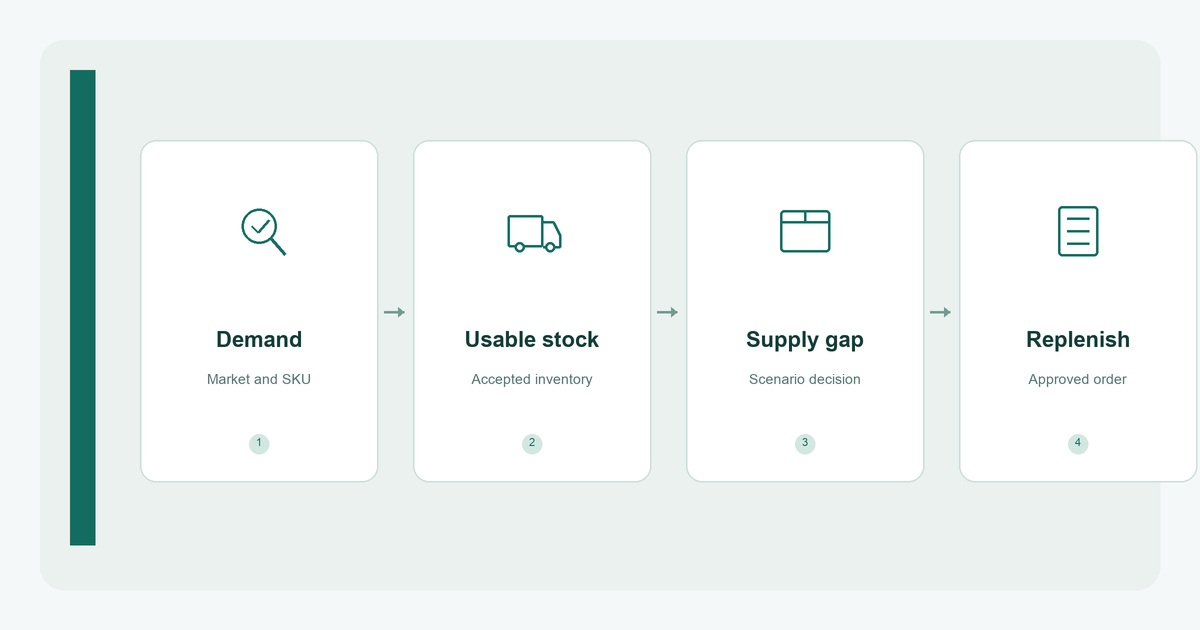
An illustrative planning calculation is expected demand during the replenishment period plus the chosen buffer, minus usable stock and eligible confirmed arrivals. Check that committed demand is handled consistently and not subtracted twice. The result is a planning proposal; supplier MOQ, cash limits, and delivery capacity can still change the approved order.
A hypothetical replenishment decision
Assume an established SKU has planned demand of 100 units per week over a six-week replenishment period. The team chooses an illustrative 150-unit buffer and has 300 usable units plus 100 confirmed arrivals within that period. The proposal is 600 plus 150 minus 300 minus 100, or 350 units. These are invented figures, not a service target or forecast for Fishgoo clients.
If the supplier MOQ is 500, show the extra 150 units as an explicit commercial decision. Compare a larger order, a revised assortment, or a different supply arrangement using their real costs. If the confirmed arrival is delayed beyond the planning period, remove it from eligible supply and review the resulting shortage. Keep the changed assumption beside the calculation.
A forecast review worksheet
- Demand: record baseline sales, confirmed commitments, promotion uplift, and the reason each assumption is included.
- Timing: separate production, inspection, consolidation, freight, destination processing, and receiving time using your own operational evidence.
- Uncertainty: show a low, base, and high scenario and the decision each would trigger. Assign the scenario review to a named person.
- Constraints: include MOQ, available cash, storage capacity, packaging commitments, and the latest acceptable receipt date.
- Decision: record the approved quantity, rationale, review date, and conditions that would change or stop the order.
Review forecast error without hiding direction
Compare actual demand with the forecast made before the purchasing decision, rather than a revised forecast created after sales are known. Show both the magnitude and direction of the difference. Repeated over-forecasting can tie up cash even when a headline average error appears acceptable. Keep low-volume items separate when percentages would exaggerate small differences.
Review Spain and Japan independently where their customer commitments, campaign calendars, or replenishment routes differ. Then aggregate only the supplier quantities that genuinely share a product specification and production plan. Use the review to change assumptions and ordering decisions, rather than treating forecast accuracy as an isolated reporting score.
Review the planning interval with finance
Show finance when cash is committed, when payments fall due, and when the expected inventory becomes saleable. A forecast can be commercially plausible while exceeding the available purchasing budget. Compare timing alternatives using the same demand assumptions. Record which quantity was deferred and what condition would authorize it later, so the sales team can see the resulting exposure instead of discovering the change during a stockout.
How Fishgoo Helps
For this workflow, Fishgoo can help coordinate supplier lead-time confirmation, purchasing follow-up and shipment consolidation, subject to the confirmed product and destination scope. Its service overview describes China-side sourcing, quality, warehouse and shipping support. Bring the approved product brief, quantity, supplier status, destination and open issues to the discussion. Confirm deliverables, fees, reporting and approval rights before work begins. The buyer retains commercial decisions and destination-market responsibilities; no automatic channel integration or guaranteed outcome is assumed.
Discuss your China sourcing and fulfillment workflow with Fishgoo.
FAQ
Can a forecast remove stockout risk?
No. A forecast improves planning but cannot remove demand, production, carrier, or customs uncertainty. Use scenarios and a documented exception plan.
Should forecasting be owned by sales or procurement?
It needs shared ownership. Sales contributes demand information, while procurement and operations translate it into lead-time, MOQ, inventory, and cash-flow decisions.
What is the most important forecast metric?
Review forecast error together with stockout rate, excess stock, lead-time variance, and service level. One accuracy percentage is not enough.
See Also
Seasonal Inventory Planning for Importers Serving Spain and Japan
Short-Video Commerce Supply Chains: Operational Requirements for Spain and Japan
TikTok Shop Supply Chain Governance for Brands
How Shopify Brands Can Build a China Supply Chain for Spain and Japan
Shopify Order Fulfillment from China for Multi-Market Operations