
TikTok Shop can create fast demand changes, but the brand still needs a controlled supply chain. Fulfillment must connect stock, supplier lead time, product quality, order SLA, packaging, carrier handoff, and returns so a campaign does not create an avoidable operational failure.
Key Takeaways
- Treat TikTok Shop as a demand channel, not a substitute for supply chain planning.
- Set stock, QC, packing, and escalation rules before a product is promoted.
- Review channel performance together with inventory and fulfillment KPIs.
Fulfillment controls for fast-moving demand
Short-video demand can be volatile. Before scaling promotion, confirm available inventory, replenishment lead time, inspection status, packing capacity, route, and customer delivery promise. A campaign should have a stop or throttle rule if stock, QC, or fulfillment capacity falls below the agreed level.
| Area | What to examine | Evidence or decision output |
|---|---|---|
| Stock | How much sellable inventory is available and how fast can the supplier replenish it? | Available and projected stock |
| Quality | Which sample, batch, inspection, and packaging standard applies? | Release evidence |
| Service | What order, dispatch, delivery, return, and escalation promise can the operation support? | Fulfillment SLA |
Create a campaign readiness gate
- Check supplier, sample, inventory, QC, and packaging status before promotion.
- Set an order-volume threshold that triggers a replenishment or capacity review.
- Monitor pick accuracy, dispatch timing, damage, and returns during the campaign.
- Record the post-campaign learning in the next demand and supplier plan.
TikTok Shop in Spain and Japan
This article uses Spain and Japan as the destination-market lenses. In Spain, include local delivery and inventory options when campaign volume rises. In Japan, confirm product information, communication, and delivery coordination before scaling. The same channel playbook should not assume identical market conditions.
Use a campaign approval gate before increasing promotion
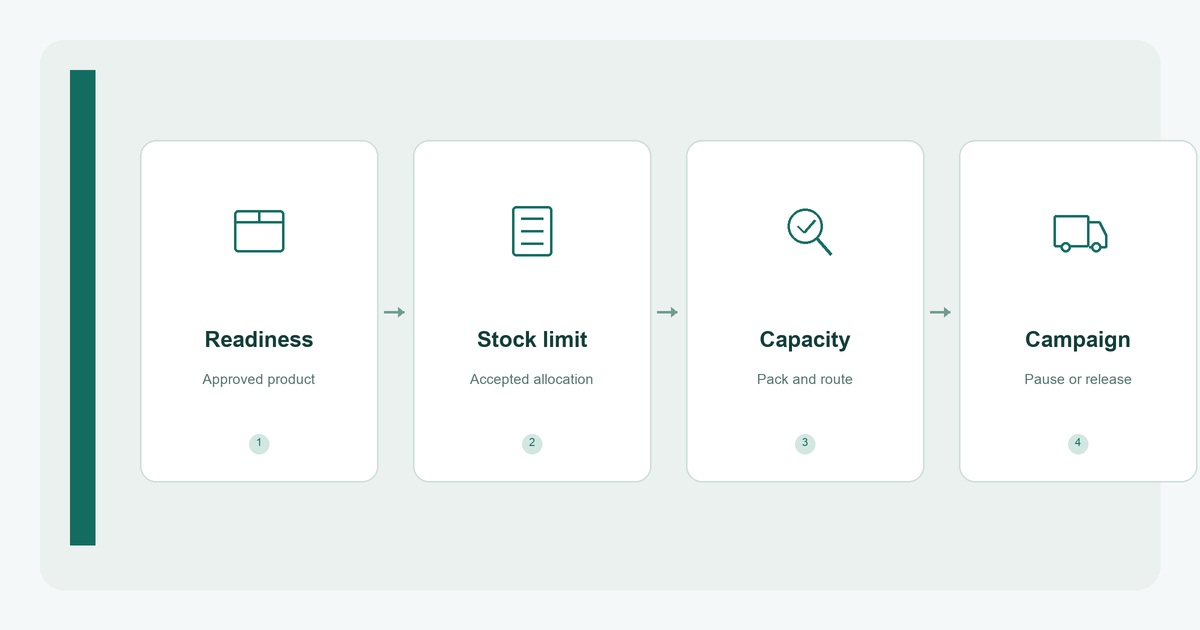
Give the campaign owner a readiness record for every promoted product. It should identify the approved product version, saleable stock, reserved commitments, packing capacity, eligible routes, and replenishment status. Ask operations to approve the quantity it can support. Marketing’s desired sales volume is an input to the plan, rather than evidence that the physical supply chain can fulfill it.
Confirm current market eligibility and account-specific platform requirements in the relevant official seller resources before launch. Channel rules can change. Keep the applicable requirements with the readiness record and record when they were reviewed. The practical controls below do not assume that Spain and Japan have identical seller policies or fulfillment arrangements.
A campaign readiness checklist
- Product: confirm the approved specification, destination version, quality evidence, and market-facing product information.
- Inventory: count accepted stock, exclude holds and existing allocations, and identify which receipts are only forecasts.
- Capacity: agree the order workload the warehouse can process with the actual packing steps and staff available.
- Route: confirm carrier coverage, handoff process, and delivery information used in the commercial promise.
- Control: set the conditions for limiting promotion, changing availability, or pausing the campaign, with a named decision owner.
- Recovery: identify how late orders, cancellations, product defects, and customer questions reach the responsible team.
Build an explicit stock and capacity limit
Consider invented figures for a single campaign: 600 accepted units are on hand, 150 are committed to other orders, and 50 are reserved under the brand’s chosen contingency policy. The potential campaign allocation is 400 units before any additional constraints. These figures are an operational example, not a recommended safety-stock level.
Now suppose the planned packing configuration limits the warehouse’s available workload below the desired campaign volume. Review the timeline, additional approved capacity, and promotion plan. Do not solve a capacity constraint by showing incoming supplier stock as immediately available. The campaign limit must reflect both eligible inventory and the operation’s ability to move it through packing and dispatch.
Agree the stop rule before a demand spike
Define which observed events require a review: accepted-stock availability approaching the chosen limit, unresolved packing errors, missing carrier handoffs, or a delayed replenishment lot. Give each trigger an evidence source and decision owner. A trigger should lead to a concrete action, such as limiting an advertised offer or reviewing customer commitments.
Have marketing and operations rehearse a hypothetical quality hold during a live campaign. Identify who changes the channel availability, who protects other accepted stock, and who follows up with the supplier. Preserve the original product record and defect evidence. Fast communication is useful when it transfers an actual decision, rather than simply creating more messages.
Review the campaign as an operating event
Compare the approved allocation with orders, cancellations, packed quantities, dispatch evidence, returns, and remaining usable stock. Keep the order cohort and observation window consistent. A campaign still awaiting delivery cannot be assessed with the same final return data as one completed earlier. Record incomplete outcomes explicitly.
Use the findings to change the next campaign’s readiness assumptions, packing instructions, or supplier plan. Confirm destination requirements with the actual Spain or Japan team rather than applying a country stereotype. This governance guide focuses on authorization and release controls; broader inventory sharing across short-video, wholesale, and other channels belongs in a separate multi-channel planning process.
Assign a backup campaign decision owner
Specify who can apply the agreed throttle or pause if the primary owner is unavailable. Give that person access to the readiness evidence and current allocation, rather than expecting a decision from a general chat message. After the event, record why the rule was applied and whether the action protected customer commitments. Update the trigger only after reviewing the actual operating evidence.
How Fishgoo Helps
For this workflow, Fishgoo can help coordinate supplier readiness, warehouse capacity and campaign stock coordination, subject to the confirmed product and destination scope. Its service overview describes China-side sourcing, quality, warehouse and shipping support. Bring the approved product brief, quantity, supplier status, destination and open issues to the discussion. Confirm deliverables, fees, reporting and approval rights before work begins. The buyer retains commercial decisions and destination-market responsibilities; no automatic channel integration or guaranteed outcome is assumed.
Discuss your China sourcing and fulfillment workflow with Fishgoo.
FAQ
Can TikTok Shop fulfillment be fully outsourced?
Some or all execution can be outsourced, but the brand still needs clear product, inventory, quality, channel, and customer-promise ownership.
What is the biggest risk during a viral campaign?
Demand can grow faster than inventory, supplier, inspection, warehouse, or carrier capacity. Use readiness gates and volume controls.
Should every product be stocked locally?
No. Choose China or local inventory based on demand confidence, lead time, cost, service promise, and cash flow.
See Also
Shopify Order Fulfillment from China for Multi-Market Operations
How Shopify Brands Can Build a China Supply Chain for Spain and Japan
Short-Video Commerce Supply Chains: Operational Requirements for Spain and Japan
Demand Forecasting for Importers: Linking Sales Plans to China Replenishment
Seasonal Inventory Planning for Importers Serving Spain and Japan