
I still remember one seller I worked with a while ago.
He found a product that was doing really well on TikTok.
The numbers looked amazing.
He found a supplier in China, checked the price, did a few calculations, and thought:
“If I can sell this for $29.99, I’m going to make a killing.”
So he launched it.
Orders started coming in.
And then the problems started.
The supplier didn’t have enough stock.
The shipping wasn’t as cheap as he expected.
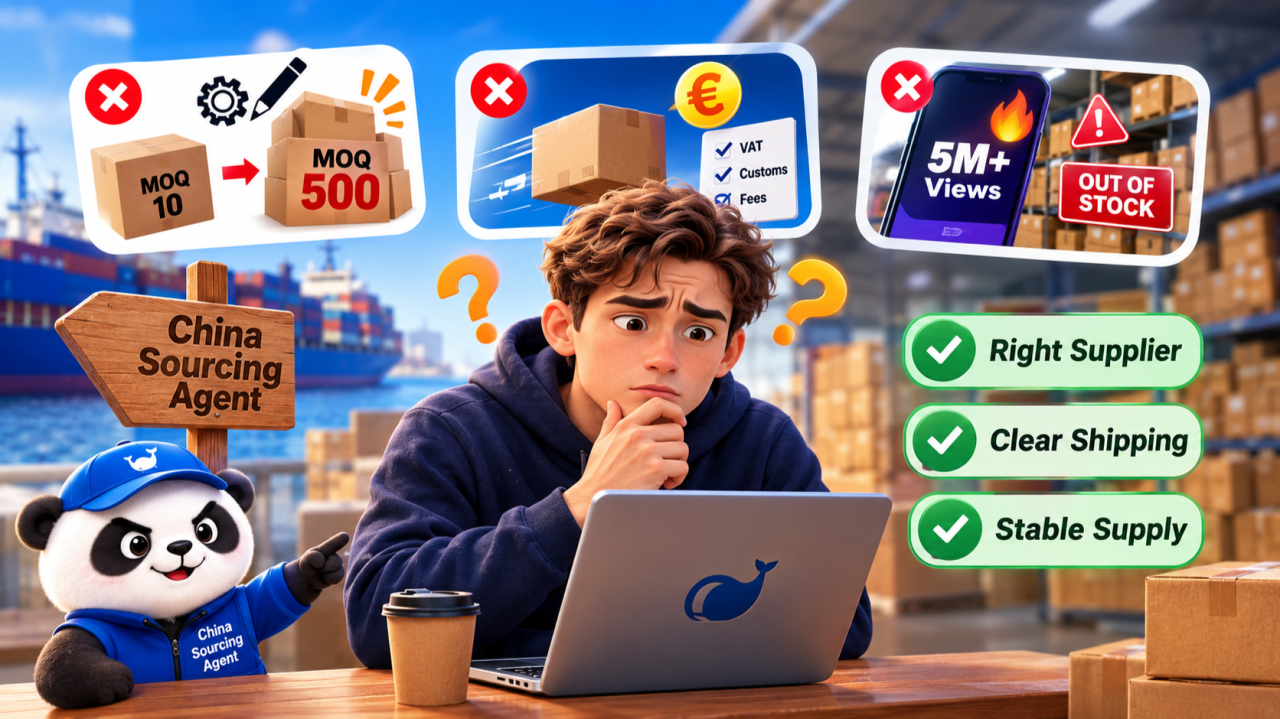
And when he asked about putting his own logo on the product, the MOQ suddenly jumped from a few pieces to hundreds.
He wasn’t doing anything unusual.
Actually, these are probably the three most common mistakes I see new dropshippers make.
Full disclosure: I’m a sourcing and dropshipping agent based in China, and I’ve worked with hundreds of sellers, especially in Europe.
Here are three lessons I wish more new sellers knew before they started scaling.
1. “MOQ 10” doesn’t always mean you can customize 10 pieces
This happens all the time.
You find a product on 1688.
The listing says:
MOQ: 10 pieces.
Great.
So you message the supplier:
“Can you put my logo on it?”
“Can you change the packaging?”
“Can you change the color?”
“Can you modify the formula?”
And suddenly the answer is:
“MOQ: 500 pieces.”
What happened?
Nothing went wrong.
You simply changed the deal.
The first MOQ was for ready-made stock.
Once you ask the factory to customize the product, packaging or formula, you’re asking them to start a different production process.
That usually means higher MOQ, higher setup costs and longer lead times.
So before you get excited about a low MOQ, ask yourself:
Am I buying something that already exists, or am I asking the factory to make something specifically for me?
That one question can save you a lot of trouble.
2. The cheapest shipping price can become the most expensive mistake
Another seller once told me:
“I found a shipping line that is $2 cheaper per order.”
Sounds good, right?
The problem came later.
The packages arrived in Europe and suddenly there were questions about VAT, customs clearance and additional fees.
Some orders were delayed.
Some customers started asking where their packages were.
And suddenly that $2 saving didn’t look so attractive anymore.
This is why I always tell sellers:
Don’t calculate your business based on product cost alone.
You need to know the real landed cost.
Product + shipping + taxes + customs + handling + everything else needed to get the product into your customer’s hands.
For many EU destinations, a properly arranged DDP shipping solution can make the process much more predictable, and delivery can often be around 7–14 business days, depending on the route and destination.
Of course, there are exceptions.
Remote islands and certain destinations can be much more complicated.
The important thing is to understand the shipping solution before you start scaling.
Not after your customers start complaining.
3. Going viral doesn’t mean your supplier is ready
This is probably my favorite one.
Because I completely understand the temptation.
You open TikTok.
You see a product everywhere.
One video has 5 million views.
Another has 2 million.
People are commenting:
“Where can I buy this?”
You think:
“I need to sell this NOW.”
So you find a supplier and start running ads.
Orders come in.
20 orders.
50 orders.
100 orders.
Then you message your supplier:
“Can you ship another 200 tomorrow?”
And the reply is:
“Sorry, out of stock.”
This is the part many new sellers don’t see.
A product can go viral overnight.
A factory usually can’t increase production overnight.
So before you scale a trending product, I always recommend checking the supply side:
- How much stock is actually available?
- Is this really a factory?
- What’s their daily production capacity?
- How quickly can they restock?
- Can they maintain the same quality?
- Have they handled dropshipping orders before?
- What happens if your order volume suddenly becomes 10x bigger?
Because a winning product with an unstable supplier isn’t really a winning business.
It’s just a problem waiting to happen.
The funny thing is, none of these mistakes are really about dropshipping
They’re about assuming everything will work exactly the way it looks on the screen.
A product listing says MOQ 10.
You assume you can customize 10.
A shipping quote says $X.
You assume that’s your final cost.
A product gets 5 million views.
You assume the factory can supply 5,000 orders.
But behind every product listing, there’s a real factory.
Behind every shipping quote, there’s a real logistics route.
And behind every viral product, there’s a real supply chain.
That’s the part I see every day from the China side.
I created this community because I think these conversations are useful for new sellers.
I’m happy to share factory resources, sourcing ideas, DDP solutions and what I’m seeing in the Chinese supply market.
But one thing I always tell people:
Don’t take my word for it either.
Verify the supplier.
Order samples.
Check the quality.
Test the shipping.
And start small before you put serious money behind a product.
That’s how you turn a product that looks like a winner into a business that can actually survive.
What’s the biggest challenge you’re facing right now?
Finding reliable suppliers?
Shipping?
Customs?
Product quality?
Or finding products that actually have stable supply?
I’d genuinely like to hear your experience.