
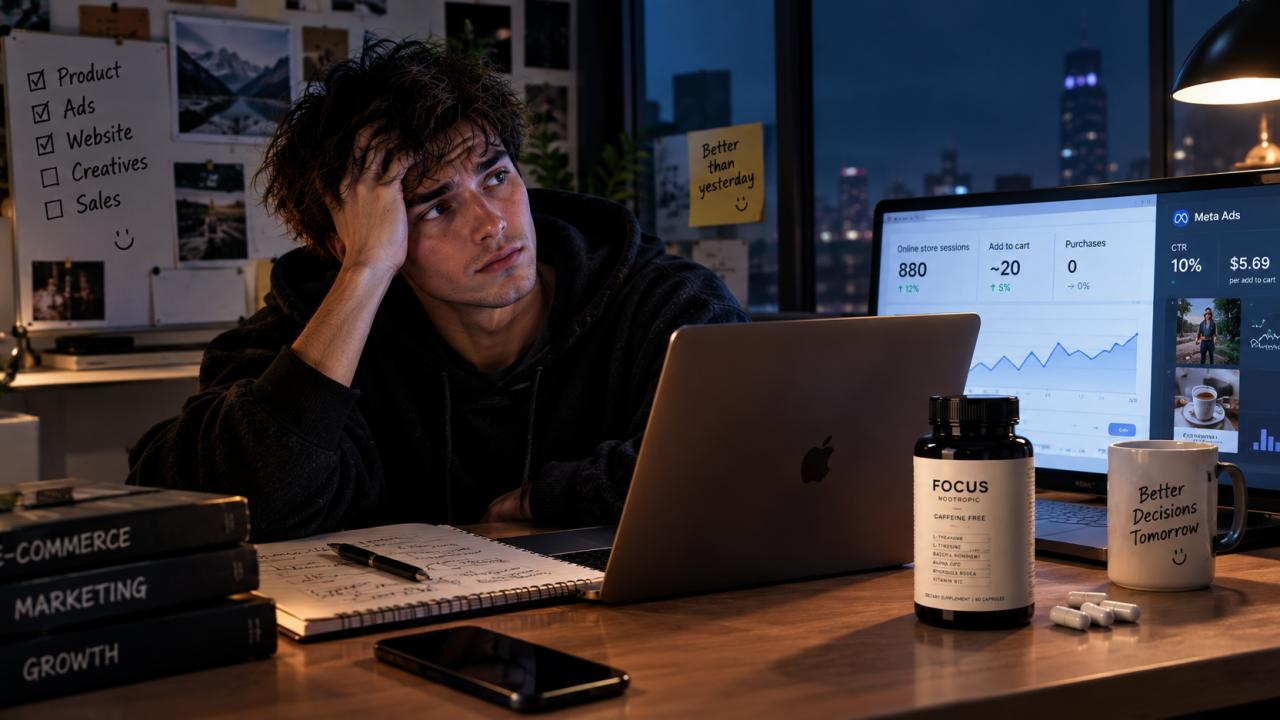

I keep seeing the same questions:
“What product should I sell?” “What interests should I target?” “How much should I spend on Meta?” “Why am I getting clicks but no sales?”
So here’s everything I’ve learned from making the mistakes myself.
No course. No guru talk. No “make $10K while sleeping.”
Just what I’ve found actually matters when building a dropshipping business in 2026.
1️⃣ First: Dropshipping is NOT passive income
Forget the Lamborghini TikToks.
Dropshipping is simply:
Customer buys → You source → Supplier ships → You keep the margin.
But that margin has to cover:
📦 Product 🚚 Shipping 💳 Payment fees 📢 Advertising 🔄 Refunds 💰 Profit
That means you’re running a real business.
And 2026 is VERY different from 2020.
Generic stores + random products + basic Facebook ads?
Good luck.
Today, the advantage comes from understanding the customer and communicating value faster than everyone else.
2️⃣ 🧠 Product > Everything
You can have:
🔥 Great ads 🔥 Great website 🔥 Great targeting
…and still lose if the product sucks.
For paid social, I look for products that make someone think:
“Wait… I need that.”
Usually because they:
- Solve a frustrating problem
- Create a strong desire
- Have an obvious “wow” factor
If you need 5 minutes to explain why someone needs it…
🚩 Red flag.
Also:
Check your economics BEFORE running ads.
My personal rule of thumb:
👉 Aim for roughly 3× sourcing cost or more as selling price.
Then calculate your break-even CPA.
If you make $20 before advertising, spending $25 to get the customer isn’t a business.
It’s a donation. 😅
And please…
ORDER A SAMPLE.
Supplier photos are not reality.
3️⃣ 🔎 How I research products
One of my favorite free tools:
Meta Ad Library.
But don’t just search product names.
Search problems.
Then look for ads that have been running for a while.
And read the comments.
Seriously.
Comments can tell you:
- What customers love
- What they hate
- What they’re confused about
- What objections they have
- What features they actually care about
That’s free customer research.
Most people scroll past it.
4️⃣ 🛍️ Your website has ONE job
When someone lands on your product page from an ad:
You have seconds to earn their trust.
Not minutes.
Not “they’ll read our About Us page later.”
Seconds.
Your product page should answer:
What is this? Why do I need it? Why should I trust you? Why should I buy now?
Your headline should sell the outcome, not just describe the product.
Your reviews should feel real.
Your trust signals should be visible.
And delete the 27 Shopify apps you installed because some YouTuber said you needed them. 😂
Every extra app can add friction.
Fast + simple + trustworthy > complicated + “professional.”
5️⃣ 📢 Meta Ads: Don’t overcomplicate it
My current testing framework is deliberately boring.
One campaign.
Purchase objective.
Broad targeting.
Minimal demographic restrictions.
Then let the creative do the heavy lifting.
The important part:
Don’t confuse audience testing with creative testing.
You can show the same broad audience:
🎯 Problem-focused creative 🎯 Lifestyle creative 🎯 Product-demo creative
Same audience.
Different reasons to care.
That’s where I often see the biggest difference.
6️⃣ 🎥 Creative is the real targeting
This is probably the biggest lesson.
Your ad isn’t just an ad.
It’s your sales pitch.
And polished doesn’t automatically mean better.
Some of my favorite creatives look like:
📱 Phone camera 🏠 Normal environment 🗣️ Real person talking 😅 Slightly imperfect delivery
Basically:
“Something my friend would send me.”
Not:
“Welcome to our $50,000 advertising campaign.”
The first 2 seconds matter A LOT.
If the hook doesn’t make someone pause…
You’ve already lost them.
So test multiple hooks around the same product.
Change the opening.
Keep the rest similar.
Sometimes one sentence can completely change the economics.
7️⃣ 📊 Stop obsessing over CTR
CTR feels amazing.
Until you check your bank account.
A high CTR means:
People clicked.
It does NOT automatically mean:
People will buy.
My preferred order when diagnosing a campaign:
CTR → ATC → Purchase → CPA → ROAS
Think of it like a funnel.
Low CTR?
Fix the creative.
Good CTR + no ATCs?
Look at the product page / offer.
ATCs + no purchases?
Look hard at checkout, trust, pricing and friction.
Purchases but bad economics?
Fix the unit economics or acquisition cost.
Don’t randomly change everything at once.
8️⃣ 🚦When should you kill an ad?
Don’t panic after one bad day.
And don’t fall in love with one good day either.
That’s one of the most expensive mistakes you can make.
My own rule:
If I’ve spent around the equivalent of the product’s selling price and I’m getting zero meaningful purchase intent, I’m willing to move on.
But if people are adding to cart?
That’s information.
Maybe the ad works.
Maybe the product works.
Maybe the website is leaking conversions.
Diagnose before you destroy.
9️⃣ 📈 Scaling isn’t “GO BIG OR GO HOME”
Found a winning ad?
Don’t immediately 10× the budget.
I’ve seen founders do this:
$30/day → $300/day
…and then wonder why everything falls apart.
My preference is much more boring:
Increase gradually.
For example:
➡️ +20–30% ➡️ Watch the data ➡️ Let it stabilize ➡️ Increase again
The goal isn’t to spend more.
The goal is to spend more profitably.
🔥 The biggest lesson
The most expensive habit in dropshipping isn’t buying the wrong product.
It’s making permanent decisions based on temporary data.
One bad day?
“Product is dead.”
One good day?
“We’re scaling to $100K!”
😂
Relax.
Data is information.
Not a verdict.
The stores that survive aren’t necessarily the ones with the craziest dashboards.
They’re often the boring ones.
Same system.
Consistent testing.
Better creatives.
Small improvements.
Week after week.
The 2026 dropshipping mindset
Don’t ask:
“How do I find a winning product?”
Ask:
“How do I build a system that can repeatedly find, test and scale opportunities?”
That’s a much bigger game.
And honestly?
It’s a lot more sustainable.
If you’re building your first ecommerce brand right now, I’d love to hear where you’re stuck:
Product? Creative? Meta Ads? Website? Conversion? Scaling?
Drop it below.
Let’s talk. 👇