
Choosing the right shipping from China can make a huge difference for your business. If you want speed, air freight usually gets packages to North America in 5 to 10 days, but costs can reach 4.5 to 5.0 USD per kg. Sea freight takes longer, sometimes up to 9 weeks, but you might pay as little as 0.20 USD per kg for a 40-foot container. When you look at air vs sea freight China, think about how urgent your orders are, how big your shipments get, and what fits your budget. FISHGOO can help you match the best shipping option to your business goals.
Key Takeaways
-
Air freight is good for urgent shipments. It delivers goods in 5 to 12 days. But it costs a lot more than sea freight.
-
Sea freight is cheaper for large shipments. It takes 20 to 45 days. This makes it good for orders that are not urgent.
-
Think about shipment size. Air freight is best for small, expensive items. Sea freight is better for big or heavy goods.
-
Look at what your business needs. Pick air freight if you want speed and reliability. Pick sea freight if you want to save money on big shipments.
-
FISHGOO gives full services for both air and sea freight. They make shipping easier and help you save time and money.
Air vs Sea Freight China: Key Differences
What Is Air Freight?
When you choose air freight, your goods travel by airplane. This method works best if you need to move products quickly from China to your destination. Air freight is popular for small, high-value items or urgent shipments. Thanks to modern airports and advanced air traffic systems in China, air freight has become even faster and more reliable. You can expect your packages to arrive in about 5 to 12 days. If you run an e-commerce business and need to restock fast, air freight might be your go-to option in the air vs sea freight china debate.
What Is Sea Freight?
Sea freight means your goods travel by cargo ship. This method suits large, heavy, or bulky shipments that are not time-sensitive. Sea freight usually takes longer—sometimes up to 45 days—but it costs much less per unit. China’s ports have grown more efficient, so you get better service and fewer delays than before. If you plan your shipments ahead and want to save money, sea freight could be the right choice for your business. Many companies use sea freight for bulk orders in the air vs sea freight china discussion.
Core Differences Explained
Let’s break down the main differences between air and sea freight. This table gives you a quick look at how they compare:
|
Factor |
Air Freight |
Sea Freight |
|---|---|---|
|
Speed |
Much faster (5-12 days) |
Slower (25-45 days) |
|
Cost |
More expensive |
Lower cost per unit |
|
Cargo Types |
Ideal for small, high-value items |
Best for bulk, heavy items |
|
Use Cases |
Time-sensitive shipments |
Planned, bulk shipments |
When you look at air vs sea freight china, think about what matters most to your business. Do you need speed, or do you want to save money? The cost comparison shows air freight costs more, but you get your goods faster. Sea freight saves money, especially for big shipments, but takes more time. With China shipping millions of containers each month to places like North America and Europe, both options offer strong support for global trade. Your choice in the air vs sea freight china question depends on your timeline, budget, and shipment size.
Sea Freight vs Air Freight: Quick Comparison
Cost Overview
When you compare sea freight vs air freight, cost stands out as a big factor. Air freight usually costs more because you pay for speed and convenience. Sea freight offers lower prices, especially for large shipments. Rates can change during busy seasons. Shipping costs often rise when demand goes up, like before holidays. Many importers book early to lock in space, which pushes prices higher. If you ship small packages, air freight might work better. For bigger loads, sea freight saves you money.
Speed and Transit Time
You want your goods fast? Air freight delivers in days. Sea freight takes weeks. Check out this table for a quick look at transit times:
|
Freight Type |
Port to Port |
Door to Door |
|---|---|---|
|
Air Freight |
1–5 days |
4–11 days |
|
Sea Freight (FCL) |
14–42 days |
19–47 days |
|
Sea Freight (LCL) |
14–42 days |
22–50 days |
Air freight gets your products to you in 5–12 days. Sea freight can take 20–45 days, sometimes longer during peak seasons. If you need to plan ahead, sea freight gives you more time to prepare.
Tip: If your shipment is urgent or you need to restock quickly, air freight is the way to go. For less urgent orders, sea freight is more budget-friendly.
Shipment Size and Volume
Shipment size matters when you pick between sea freight vs air freight. Air freight works best for small and light packages. Sea freight handles heavy and bulky items. Here’s a quick guide:
-
For loads over 500 kg, sea freight becomes much cheaper.
-
Ocean freight can cost $195 for big shipments, while air freight might cost $1,000 for the same weight.
If you run an e-commerce store and ship small, high-value items, air freight fits your needs. For bulk orders or large inventory, sea freight is the smarter choice.
China Air Freight: When to Choose It
Best for Urgent and High-Value Goods
You want your goods fast? China air freight gives you speed and reliability. If you run an e-commerce store or need to restock quickly, air freight helps you stay ahead. You can ship products in days, not weeks. This method works best for urgent shipments and high-value items. You pay more, but you get your goods on time.
Here are the types of goods you often ship by air freight from China:
-
General cargo like dry products, household items, sports equipment, and clothing
-
Special cargo that needs extra care, such as:
-
Dangerous goods
-
Time sensitive products
-
Perishable cargo
-
Fragile goods
-
Live animals
-
Wet cargo
-
If your business deals with fragile or perishable items, air freight keeps them safe and fresh. You avoid delays and reduce risks. When you need to ship time sensitive products, air freight is your best option.
Tip: If you need to deliver products quickly to customers or want to launch a new item fast, choose air freight. You get peace of mind knowing your shipment will arrive on schedule.
Choosing air freight for urgent shipments from China costs more than sea freight. Rates can be up to 16.7 times higher. You pay for speed, weight, and extra fees like terminal handling and customs clearance. If you need fast delivery, the higher cost may be worth it.
FISHGOO B2B Commercial Services for Air Freight
FISHGOO makes china air freight simple for your business. You get a full-service solution that covers sourcing, quality checks, and fast shipping. FISHGOO handles supplier communication and price negotiation. You can submit product links, and FISHGOO takes care of the rest.
With FISHGOO, you enjoy:
-
Automated order fulfillment
-
Real-time tracking
-
Custom packaging for fragile items
-
Access to over 3,000 shipping routes
You save time and avoid mistakes. FISHGOO’s warehouses in China and Spain help you manage inventory and ship products quickly. If you want reliable china air freight, FISHGOO gives you the tools to grow your business.
Sea Freight: When It’s the Better Option
Ideal for Bulk and Non-Urgent Shipments
If you ship large orders or don’t need your goods right away, sea freight makes a lot of sense. You get more space for your products, and you pay less per unit. Once your shipment goes over 1 cubic meter, sea freight becomes a smart choice. You can use LCL (Less than Container Load) if you don’t fill a whole container. This helps you save money and still move a lot of goods.
Here’s why many businesses pick sea freight for bulk shipping:
-
Cost-effective: You pay much less per kilogram compared to air freight.
-
Large volume capacity: Ships carry huge amounts of cargo, so you can send big orders at once.
-
Environmentally-friendly: Sea freight has a smaller carbon footprint for each ton shipped.
-
Versatile: You can ship almost anything, even oversized or hazardous items.
Check out this table to see how sea freight compares to air freight for price and volume:
|
Criteria |
Air Freight |
Sea Freight |
|---|---|---|
|
Price per Kg |
2.50-8.00 USD |
0.03-0.50 USD |
|
Example Route (Shenzhen-LA) |
~8,000 USD |
~1,500 USD |
|
40′ Container |
N/A |
2,287-2,309 USD |
|
Key Routes Sea |
N/A |
Shanghai-Rotterdam: ~3,900 USD; Shanghai-USC: 2,000-2,500 USD |
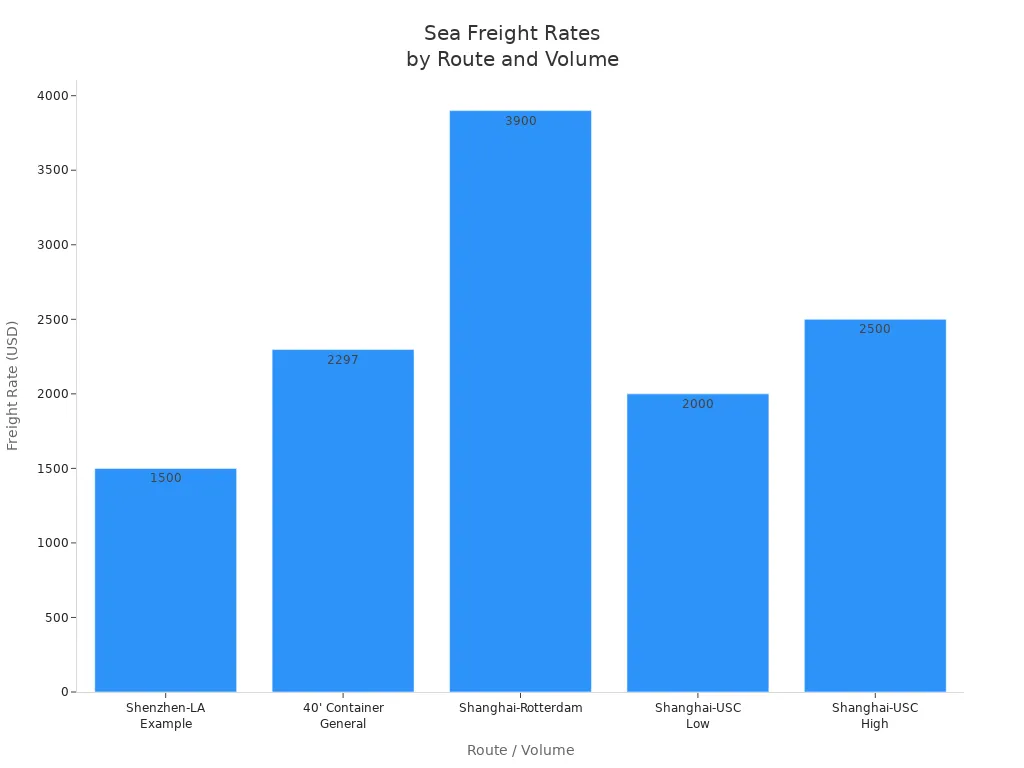
You can see that sea freight gives you the best value for big shipments. If you want to lower costs and ship more at once, this method works well.
FISHGOO Solutions for Sea Freight
FISHGOO helps you make the most of china sea freight. You get support for every step, from sourcing products to final delivery. FISHGOO manages supplier talks, quality checks, and warehouse storage. You can store your goods in China or Spain for up to 100 days for free.
You also get:
-
Access to over 3,000 shipping routes worldwide
-
DDP shipping, so you don’t worry about customs or hidden fees
-
Custom packaging for fragile or special items
-
Automated order fulfillment that connects with your online store
With FISHGOO, you ship bulk orders smoothly and keep your costs low. You can focus on growing your business while FISHGOO handles the details.
Reliability, Safety, and Environmental Impact
Reliability and Safety Comparison
When you ship products from China, you want them to arrive safely and on time. Air freight is fast and reliable. Your goods usually get to you quickly. There are fewer delays with air freight. Sea freight costs less, but it can take longer. Ships sometimes face delays or changes in schedule.
Here’s a simple table to compare air and sea freight:
|
Mode of Freight |
Transit Time |
Reliability Rate |
|---|---|---|
|
Air Freight |
Higher |
|
|
Sea Freight |
20-40 days |
Lower |
Safety is important for both air and sea freight. They both have rules to keep your cargo safe. Here are some main safety steps:
|
Safety Concern |
Air Freight |
Sea Freight |
|---|---|---|
|
Hazard Communication |
Clear hazard labels and handling marks |
Proper cargo documentation procedures |
|
Dangerous Goods Declaration |
Shipper’s Declaration for Dangerous Goods |
Compliance with SOLAS standards |
|
Emergency Preparedness |
Adherence to DGR for hazardous materials |
Standards for ship construction and equipment |
|
Tracking and Security |
Real-time tracking |
AIS transponders and ISPS Code provisions |
You must follow all the rules to avoid problems or fines. SOLAS rules help ships stay safe and ready for emergencies. Good paperwork helps people handle dangerous goods the right way. Insurance prices are different for each method. Air freight insurance is about 0.2% to 0.5% of your cargo’s value. Sea freight insurance is about 0.3% to 0.8%.
Environmental Considerations
If you want to help the planet, sea freight is better. Ships make much less CO2 than planes. For the same trip, air freight makes 40 to 50 times more carbon emissions per ton-mile. For example, planes give off about 1,054 kg of CO2 for every 1,000 km. Ships only give off about 20 kg.
Both shipping and air companies now try to use cleaner fuels. They want to protect the environment. The shipping industry is working to lower emissions. Air cargo companies are also testing new fuels to help the earth. Some insurance and finance companies give rewards to businesses that pick eco-friendly shipping.
Tip: If you want to help the environment, choose sea freight for big shipments.
Choosing the Right Shipping Method for Your Business
Key Decision Factors
You want your goods to arrive safe and on time. You also want a good price. Picking the best shipping means looking at many things. Here’s what you should think about:
-
Cost: Sea freight is cheaper if you want to save money. Air freight costs more, but it is faster.
-
Delivery speed: Air freight is best for urgent shipments. It is good for perishable goods or fast-selling items.
-
Cargo type: Some products need special care. Fragile or expensive items often go by air. Heavy or big goods are better for sea freight.
-
Reliability: You want a shipping company you can trust. Pick partners with a good record for on-time deliveries.
-
Shipment urgency and volume: Air freight is best for urgent needs. Sea freight is better for large shipments, especially over 100-500 kg.
-
Route and destination: Think about where your factory is and where your goods go. Sometimes, using rail or mixing routes can save time.
-
Administrative requirements: Make sure you have all the right papers. You need customs forms, packing lists, and certificates for shipping.
Tip: Try to balance cost, speed, and safety. If you need fast shipping, air freight is best. If you want to save money and ship a lot, sea freight is better.
Here’s a table showing how FISHGOO’s solutions help with these things:
|
Benefit |
Description |
|---|---|
|
Integrated Fulfillment |
Quality checks are part of the process, making things work better. |
|
Operational Efficiency |
Combining sourcing and shipping makes everything run smoother. |
|
Logistics Optimization |
Over 3,000 shipping routes and 180 countries help you ship smarter. |
|
Scalable Infrastructure |
Systems built to grow with your business for the long term. |
|
Faster Fulfillment |
Faster shipping meets what customers want today. |
|
Reliable Suppliers |
Better control means you can trust your suppliers more. |
Practical Scenarios for E-commerce and Amazon FBA
You have an e-commerce store or sell on Amazon FBA. You need to pick the right shipping for your business. Let’s look at some examples:
Small Shipments for E-commerce
If you send small packages, like phone cases or jewelry, air freight is fast. You can restock quickly and keep customers happy. You pay more, but you avoid waiting. Always include the shipping address, order date, and contact info. Give a list with SKUs or barcodes. Good customs papers help you avoid delays.
Bulk Orders for Retailers
You want to send hundreds of products at once. Sea freight saves you money for big shipments. It takes longer, but you pay less. Include a packing slip, order number, and certificate of origin. Work with a trusted freight partner to handle customs and avoid problems.
Amazon FBA Shipments
Shipping to Amazon FBA can be hard. Amazon has strict rules for quality, packaging, and labels. If you miss something, your shipment may get canceled. Always follow Amazon’s rules. Use the right papers and special packaging. FISHGOO’s system helps you do this. You get quality checks, custom packaging, and fast shipping. This keeps your supply chain working well.
Global Ecommerce Supply Chain Optimization
You want to grow your business around the world. FISHGOO puts sourcing, warehousing, and DDP shipping together. You get over 3,000 shipping routes. This helps you save money and time. You can grow your business without worrying about shipping problems.
Note: Always check routes and shipping times before you book. Busy times can cause delays and higher prices. If people do not talk clearly, mistakes can happen. FISHGOO’s platform keeps things clear and organized.
Best Practices for Freight Forwarding
-
Pick a freight partner who knows international shipping.
-
Balance cost, speed, and safety.
-
Make sure all papers are typed and complete.
-
Learn about import taxes for your country.
-
For US inland places, rail from the West Coast can be faster than shipping straight to the East Coast.
If you want to avoid delays and high costs, use FISHGOO’s solutions. You get trusted suppliers, faster shipping, and better shipping times. This helps your business compete and keeps your customers happy.
You have a lot to think about—cost, speed, shipment size, reliability, and your business type. Check out this quick table to help you decide:
|
Shipping Method |
Pros |
Cons |
|---|---|---|
|
Air Freight |
Fast, great for urgent or high-value goods |
Costs more, not ideal for big loads |
|
Sea Freight |
Cheaper for bulk, good for non-urgent items |
Takes longer, not for rush orders |
Think about what matters most for your business. If you need speed, go with air freight. For big, non-urgent shipments, sea freight saves money. FISHGOO’s B2B services make both options easy. Want help picking the best route? Reach out to FISHGOO for advice that fits your needs.
FAQ
How do I decide between air and sea freight for my shipment?
Think about your budget, how fast you need your goods, and how big your shipment is. Air freight works best for urgent or small orders. Sea freight saves money for large, non-urgent shipments.
What documents do I need for shipping from China?
You need a commercial invoice, packing list, and bill of lading or air waybill. Customs may ask for extra papers like certificates of origin or import licenses. FISHGOO can help you get everything ready.
Can I track my shipment with FISHGOO?
Yes! You get real-time tracking for both air and sea freight. You can check your shipment’s status anytime on your dashboard. This helps you plan and stay updated.
What is DDP shipping, and why should I use it?
DDP means Delivered Duty Paid. You pay one price that covers shipping, customs, and taxes. You avoid surprise fees and delays. FISHGOO handles all the details for you.