
When choosing between DDP, FOB, and CIF, you should match the shipping term to your needs. DDP works best if you want maximum convenience. FOB suits you if you prefer more control over shipping. CIF fits buyers looking for a balance of cost and risk. Your choice affects total landed cost, risk exposure, and convenience. For example, CIF includes freight and insurance in the customs value, which can raise your costs. FOB can help lower duty charges on high-value goods. FISHGOO helps you shop and ship from China with trust and ease, making the DDP vs FOB vs CIF decision simpler.
Key Takeaways
-
Pick DDP if you want things to be easy. The seller takes care of shipping, customs, and duties. You do not have to worry about anything.
-
Choose FOB if you want to be in charge. You handle costs and shipping after the goods are on the ship.
-
Go with CIF if you want to share cost and risk. The seller pays for shipping and insurance. You take care of customs and delivery when the goods arrive.
-
Know how much each term costs. DDP covers all costs at the start. FOB and CIF might have extra fees after shipping.
-
Think about your skills and what you need. New buyers like DDP or CIF because they are simple. People with more experience pick FOB for more control.
Incoterms Overview
What Are Incoterms?
You might hear incoterms when talking about shipping. Incoterms means International Commercial Terms. The International Chamber of Commerce made incoterms to help buyers and sellers know their jobs in global trade. Incoterms 2020 is the newest version. It sets clear rules for shipping goods between countries. If you use incoterms 2020, you know who does each step in shipping.
Incoterms 2020 has many common terms. Here are the official meanings for some popular ones:
-
FOB (Free On Board): The seller puts and loads the goods on the transport at the named port. You take all risks and costs after this point.
-
CIF (Cost, Insurance and Freight): The seller loads the goods on the ship they pick. The seller pays for freight and insurance to the named port.
Incoterms 2020 also includes DDP, which means Delivered Duty Paid. With DDP, the seller handles almost everything. This includes shipping, insurance, and customs duties. You get the goods at your door with little work.
Why Incoterms Matter
Incoterms 2020 makes international trade easier. Using incoterms helps you avoid confusion and mistakes. Incoterms 2020 gives everyone a set of rules to follow. This helps you and your trading partner know what will happen.
Here is how incoterms 2020 help you:
-
Incoterms give a standard way to show what buyers and sellers must do.
-
They help people talk clearly, which is important in global trade.
-
With common terms, they lower the chance of misunderstandings.
-
Incoterms show who pays costs and takes risks at each transport stage.
-
They make clear who handles transportation, costs, and risks, so logistics run better.
-
This helps businesses with customs and knowing who pays for what.
Using incoterms 2020 makes shipping smoother and safer. You can trust that everyone knows their job. Incoterms 2020 help you save time, stop arguments, and keep your business working well.
DDP vs FOB vs CIF Explained
When you compare ddp vs fob vs cif, you see three different ways to ship goods. Each term changes who pays, who takes the risk, and who handles the work. You need to know what each one means before you choose.
DDP Meaning
DDP stands for Delivered Duty Paid. When you use ddp, the seller does almost everything for you. You do not have to worry about shipping, customs, or taxes. The seller brings the goods to your door. You only need to unload them.
Here is what the seller does under ddp:
-
The seller delivers the goods to your chosen place.
-
The seller tells you when the goods arrive.
-
The seller handles all customs steps, including export and import.
-
The seller pays for all transport, no matter the method.
-
The seller does not have to buy insurance, but they take all the risk until you get the goods.
-
You only need to unload the goods.
You can see that ddp gives you the most comfort. You do not need to know much about shipping rules. You do not need to deal with customs. The seller takes care of everything. When you look at ddp vs fob vs cif, ddp is the best choice if you want a simple process.
FOB Meaning
FOB means Free On Board. When you use fob, the seller brings the goods to the ship at the port. The seller loads the goods onto the ship. After that, you take over. You pay for the sea journey, insurance, and all steps after the goods are on the ship.
Here is what happens with fob:
-
The seller gives you the goods and the right papers.
-
The seller gets export licenses and handles export steps.
-
The seller pays to move the goods to the port and loads them on the ship.
-
The seller tells you when the goods are on board.
-
You choose the ship and tell the seller.
-
You pay for the sea trip and insurance if you want it.
-
You handle customs, taxes, and delivery after the ship leaves.
-
You pay for unloading and moving the goods to your place.
FOB gives you more control. You can pick your shipping company. You can manage costs after the goods leave the port. When you compare ddp vs fob vs cif, fob is good if you want to handle shipping and save money by choosing your own partners.
CIF Meaning
CIF stands for Cost, Insurance, and Freight. When you use cif, the seller pays for the goods to reach your port. The seller also buys insurance for the trip. Once the goods are on the ship, the risk moves to you. You must handle customs, taxes, and delivery from the port to your place.
Here is what cif means for you:
-
The seller brings the goods to your port.
-
The seller gives you the papers you need to get the goods.
-
You pay for customs, taxes, and moving the goods from the port.
-
You unload the goods and pay for storage if needed.
CIF is a middle choice in ddp vs fob vs cif. You get some help from the seller, but you also take on some work and risk. CIF works well if you want the seller to handle shipping and insurance, but you want to manage customs and delivery in your country.
Tip: When you look at ddp vs fob vs cif, think about how much work you want to do and how much risk you want to take.
Here is a table to help you see the main differences:
|
Shipping Term |
Cost Allocation |
Risk Transfer |
Responsibility |
|---|---|---|---|
|
DDP |
Seller covers all costs including shipping, customs, and duties. |
Risk stays with the seller until you get the goods. |
Seller handles all logistics and customs. |
|
CIF |
Seller pays for shipping and insurance to your port. |
Risk moves to you once goods are on the ship. |
You handle customs and delivery from the port. |
|
FOB |
Seller pays up to the port of departure. |
Risk moves to you once goods are on the ship. |
You handle all steps after loading. |
When you compare ddp vs fob vs cif, you see that ddp gives you the least work, fob gives you the most control, and cif gives you a balance. You should choose the one that fits your needs.
DDP Shipping
How DDP Works
When you choose ddp, or delivered duty paid, you let the seller handle almost every step. The ddp process starts when you submit your request with product details. A manager discusses logistics with you to avoid mistakes. You get a clear freight cost and can add services like insurance. The seller picks up your cargo from the supplier’s warehouse in China. They prepare and move your goods to the port or airport. Export clearance happens in China, then your goods ship to your country. When the container arrives, the seller clears it for import. Finally, your goods reach your warehouse. You only need to unload them.
You must make sure your commercial invoice and packing list match the cargo. Proper documents and following rules help avoid delays.
DDP Pros
You get many benefits with ddp shipping, especially when using FISHGOO. Here is a table showing the main advantages:
|
Advantage |
Description |
|---|---|
|
Cost Transparency |
You see all costs up front, so you can plan your budget. |
|
Simplified Logistics |
The process is easy. You do not need to manage many steps. |
|
Reduced Administrative Burden |
You do less paperwork and spend less time on shipping tasks. |
|
Cost Certainty |
You lock in your final costs and avoid surprise fees. |
|
Faster Time-to-Market |
Your goods arrive quickly, so you can sell them sooner. |
DDP Cons
You may face some drawbacks with ddp. You have less control over the import process and shipping methods. The total cost can be higher than fob or cif. You might not see every step in the supply chain. Sometimes, shipping can be slower. You may get less information if there are delays. It can be hard to compare costs with fob or cif.
When to Use DDP
You should use ddp when you want a worry-free experience. Delivered duty paid works well for cross-border e-commerce, overseas wholesalers, and high-tax goods. It is also good for new buyers who want a fixed price and reliable delivery. FISHGOO makes ddp the best choice if you want convenience and trust when shopping from China. If you do not want to handle customs or paperwork, ddp is the most convenient option. For buyers who want more control, fob or cif may fit better.
FOB Shipping
How FOB Works
When you choose fob, you use the free on board shipping term. The seller loads your goods onto the ship at the port in China. After the goods are on the vessel, you take over. You pay for the ocean freight, insurance, and all costs to your final destination. You must handle customs clearance and arrange for delivery after the ship leaves China.
Here is what you need to do with fob shipping:
-
You cover all costs from the seller’s warehouse to your door.
-
You must have a commercial invoice, packing list, and bill of lading.
-
You need to work with a freight forwarder for customs clearance.
-
Your choice of incoterm, such as fob or cif, changes your costs and responsibilities.
FOB Pros
Fob shipping gives you more control over your shipping process. You can choose your own shipping company and insurance. This helps you manage costs and pick the best route. You can also build strong relationships with logistics providers. Fob works well for large orders and growing businesses. It gives you flexibility that cif or ddp may not offer. FISHGOO supports buyers who want to take charge of their shipping and make smart choices.
FOB Cons
Fob shipping can be hard if you have little experience. You must manage ocean transit, insurance, and customs clearance. You may face higher upfront costs, which can put pressure on your budget. There is a greater chance for disputes about the condition of goods during transport. You need to select carriers and manage unloading at the port. If you are new to shipping, cif or ddp may be easier.
-
You have more logistics to manage.
-
Upfront costs can strain your finances.
-
Disputes about damaged goods are more likely.
When to Use FOB
You should use fob when you want more control and have some shipping experience. Free on board is a good choice for most buyers. It is the safest default option and helps you avoid confusion with suppliers. Fob lets you control shipping costs and works well if you use a sourcing agent. If you want to scale your business, fob is a smart choice. Many buyers prefer fob over cif because it gives them more power over the process.
Tip: If you want to balance control and cost, compare fob with cif and ddp before you decide.
CIF Shipping
How CIF Works
When you pick cost, insurance and freight, the seller does many steps for you. Here is how cif shipping works:
-
The seller packs your products and gets them to the port.
-
The seller loads and unloads goods at the port and gives customs papers.
-
The seller arranges sea shipping after loading your goods on the ship.
-
You pay the freight cost the seller tells you.
-
You take the risk once the goods are on the ship.
-
You finish import customs and pay fees when the goods arrive.
-
You set up transport and unloading at your warehouse.
This incoterm lets you focus on your business. The seller handles shipping and insurance until your port.
CIF Pros
Cost, insurance and freight has many good points for buyers who want a balance of cost and risk. Here is a table to show the benefits:
|
Advantage |
Description |
|---|---|
|
Seller Convenience |
The seller puts costs in one quote, so pricing is simple. |
|
Buyer Protection |
Insurance is included, so you worry less, even if you are new to sea shipping. |
|
Cost Predictability |
Fixed freight and insurance help you plan your budget. |
|
Simplified Cost Management |
The seller gives you one invoice with all costs. |
|
Convenience |
The seller takes care of shipping and insurance for you. |
|
Negotiation Leverage |
Sellers may get better prices and share savings with you. |
|
Focus on Core Operations |
You can spend more time on your main business, not shipping. |
FISHGOO helps you use cif shipping from China. They make the process easy and clear. You can trust FISHGOO to handle details and help you balance cost and risk.
CIF Cons
Cost, insurance and freight also has some risks. You should know these before you pick cif:
|
Risk Area |
Description |
|---|---|
|
Transit loss or damage |
You might lose goods or have damage after loading, and insurance may not pay much. |
|
Insurance coverage gaps |
Basic insurance may not cover theft or breakage. |
|
Claims burden on buyer |
You must file claims yourself, even though the seller buys insurance. |
|
Carrier liability limits |
You may get less money than your cargo is worth if there is a problem. |
|
Destination cost surprises |
Seller’s route choices can mean extra fees you did not expect. |
|
Documentation issues |
Mistakes in papers can cause customs delays. |
|
Customs valuation issues |
Wrong values can lead to fines or more waiting. |
|
Rollover/transshipment |
Delays can happen if ships miss connections or ports are busy. |
|
General Average (GA) |
You may need to pay security if the ship has problems. |
|
Sanctions/route changes |
World events can change routes at the last minute. |
|
Unsuitable for containers |
CIF is not the best for container cargo. |
When to Use CIF
You should use cost, insurance and freight if you want the seller to handle shipping and insurance to your port. This incoterm is best if you do not want to manage sea shipping or if you are new to global trade. But cif can give you less control over costs, especially for customs and local fees. Many experts say fob is better if you want more control. If you want to avoid surprises and keep things easy, cif can be a good choice. FISHGOO can help you decide if cif is right for your shipment from China.
DDP vs FOB vs CIF Table
When you choose a shipping term, you need to see how each one affects your shipment. DDP, FOB, and CIF all have different rules for cost, risk, and responsibility. You want to know who pays for what, who takes the risk, and who does the work. This table helps you compare the three terms for your next shipment.
|
Incoterm |
Cost Responsibility |
Risk Responsibility |
Key Features |
|---|---|---|---|
|
DDP |
Seller covers all costs, including duties and taxes |
Seller bears all risks until delivery |
Maximum responsibility on seller, hassle-free for buyer |
|
FOB |
Seller covers costs until goods are loaded on board |
Risk transfers to buyer once loaded |
Clear transition point, useful for bulk shipments |
|
CIF |
Seller covers cost, insurance, and freight to destination |
Seller bears risks until goods reach destination port |
Provides risk mitigation for buyers during transit |
Tip: Always check the details of your shipment before you pick a term. Each incoterm changes how you handle your shipment and how much you pay.
You see that DDP gives you the most comfort. The seller pays for everything and takes all the risk until your shipment arrives. You do not need to worry about customs or taxes. FOB lets you control your shipment after the goods are on the ship. You pay for the rest of the journey and take the risk from that point. CIF gives you some protection because the seller pays for insurance and shipping to your port. You take over when the shipment reaches your port.
Many buyers ask about exw. Exw means the seller only makes the goods available at their place. You do all the work and pay all costs from there. Exw is not in the table, but you should know it. Exw puts all the responsibility on you. If you want to compare exw with DDP, FOB, or CIF, think about how much work you want to do for your shipment. Exw is the simplest for the seller but the hardest for you. You must arrange every step of the shipment. Exw works best if you have a strong logistics team. If you want less work, DDP is better. If you want some control, FOB or CIF may fit your shipment.
You should always match the shipping term to your needs. Look at your shipment size, your experience, and your budget. Exw, DDP, FOB, and CIF all change how you handle your shipment. Exw gives you the most control but also the most work. DDP gives you the least work. FOB and CIF give you a balance. For every shipment, review your options and pick the best one.
Choosing Shipping Terms
Cost Factors
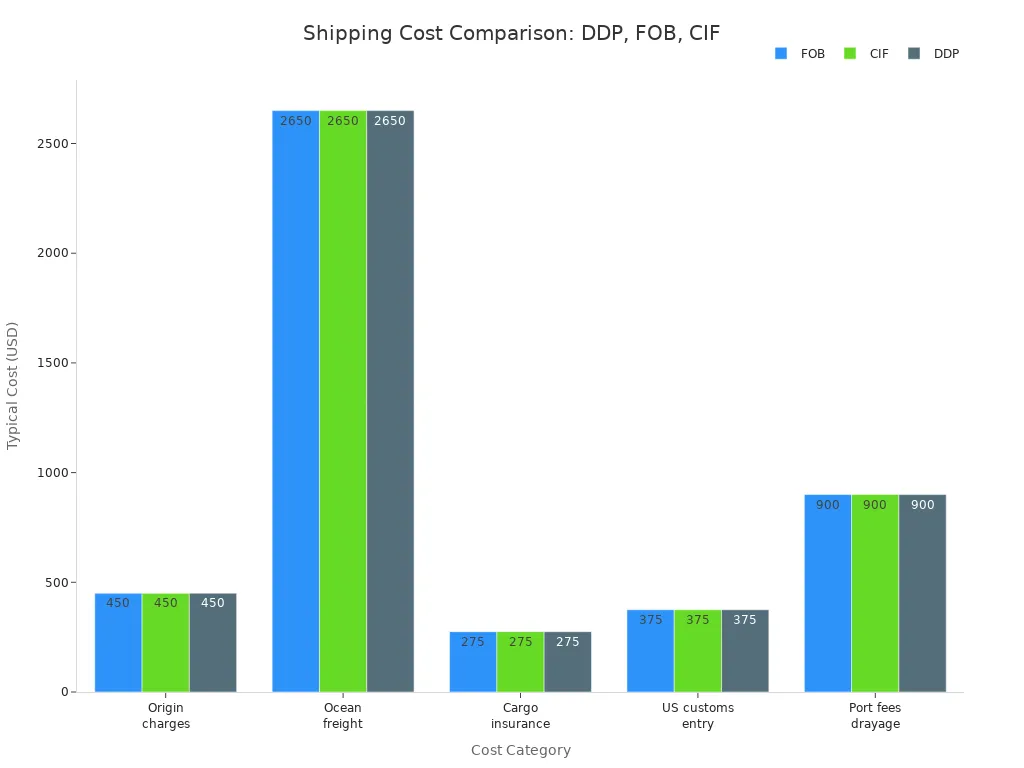
You need to think about costs when picking a shipping term. Each choice changes what you pay for shipping from China. DDP covers all costs, like customs duties and delivery. CIF includes shipping and insurance to your port, but you pay for customs and delivery to your place. FOB lets you control costs after the goods leave China. Here is a table that shows common costs for shipping from China:
|
Cost line |
Typical range |
FOB |
CIF |
DDP |
|---|---|---|---|---|
|
Goods value |
$50,000 |
Buyer |
Buyer |
Buyer (in price) |
|
Origin charges + export customs |
$300-$600 |
Seller |
Seller |
Seller |
|
Ocean freight |
$1,800-$3,500 |
Buyer |
Seller |
Seller |
|
Cargo insurance |
$150-$400 |
Buyer |
Seller |
Seller |
|
US customs entry + bond |
$250-$500 |
Buyer |
Buyer |
Seller |
|
Import duties and fees |
Depends on HS code |
Buyer |
Buyer |
Seller |
|
Port fees + drayage to door |
$600-$1,200 |
Buyer |
Buyer |
Seller |
Control and Responsibility
You need to decide how much control you want. DDP gives you very little responsibility. The seller does everything, including customs. FOB gives you lots of control and responsibility. You handle shipping after the goods are loaded. CIF gives you some control and responsibility. The seller handles shipping and insurance, but you take care of customs and delivery.
|
Shipping Term |
Control Level |
Responsibility Level |
Description |
|---|---|---|---|
|
DDP |
Minimal |
Low |
Seller handles everything including customs and duties. |
|
FOB |
High |
High |
Buyer takes responsibility once goods are loaded onto the vessel. |
|
CIF |
Moderate |
Moderate |
Seller arranges freight and insurance, but buyer assumes risk once goods are loaded. |
Risk and Insurance
Risk and insurance change with each shipping term. DDP protects you from most risks. The seller pays for insurance and takes care of your goods until they arrive. FOB puts risk on you after the goods are on the ship. You pick the carrier and insurance. CIF gives you basic insurance, but you take care of the goods after loading. You need to check if the insurance covers all risks.
Convenience
Convenience is important for shipping from China. DDP is the easiest. You do not worry about shipping or customs. CIF is easy if you want the seller to handle shipping and insurance. FOB is best if you want to manage shipping and save money. New buyers often pick CIF because it is simple while learning about shipping.
Practical Scenarios
You should pick the shipping term that fits your needs. If you want no stress, choose DDP. If you want to control shipping and costs, pick FOB. If you want a mix, select CIF. FISHGOO helps you with shipping, making things easy. You can trust FISHGOO to help you, whether you are new or experienced. Think about your business, your skills, and how much responsibility you want. Pick the term that matches your goals.
You now know the key differences between DDP, FOB, and CIF.
-
Choose DDP if you want the most convenience.
-
Pick FOB for more control over your shipping.
-
Select CIF to balance cost and risk.
Think about your business needs and experience. FISHGOO can help you shop and ship from China with confidence. For complex shipments, talk to a logistics expert for the best results.
FAQ
What does ex works mean in shipping?
Ex works means the seller makes goods available at their place. You pick up the goods and handle all shipping steps. You pay all costs from the seller’s door to your location. Ex works gives you full control but also full responsibility.
How does transfer of risk work in international shipping?
Transfer of risk shows when you become responsible for the goods. In ex works, transfer of risk happens at the seller’s warehouse. For DDP, the seller keeps risk until you get the goods. Always check when transfer of risk takes place.
When should you choose ex works over other shipping terms?
You should choose ex works if you want to manage every part of shipping. Ex works works best if you have strong logistics experience. You can save money by picking your own carriers and routes. Small businesses often avoid ex works due to its complexity.
Is ex works suitable for new importers?
Ex works is not the best for new importers. You must handle customs, shipping, and paperwork. Mistakes can cost you time and money. Most new buyers start with DDP or CIF before trying ex works.
Can you combine ex works with FISHGOO’s services?
You can use ex works with FISHGOO if you want to control shipping. FISHGOO helps you verify products and prepare documents. You arrange pickup and shipping. Ex works gives you freedom, while FISHGOO adds trust and support.