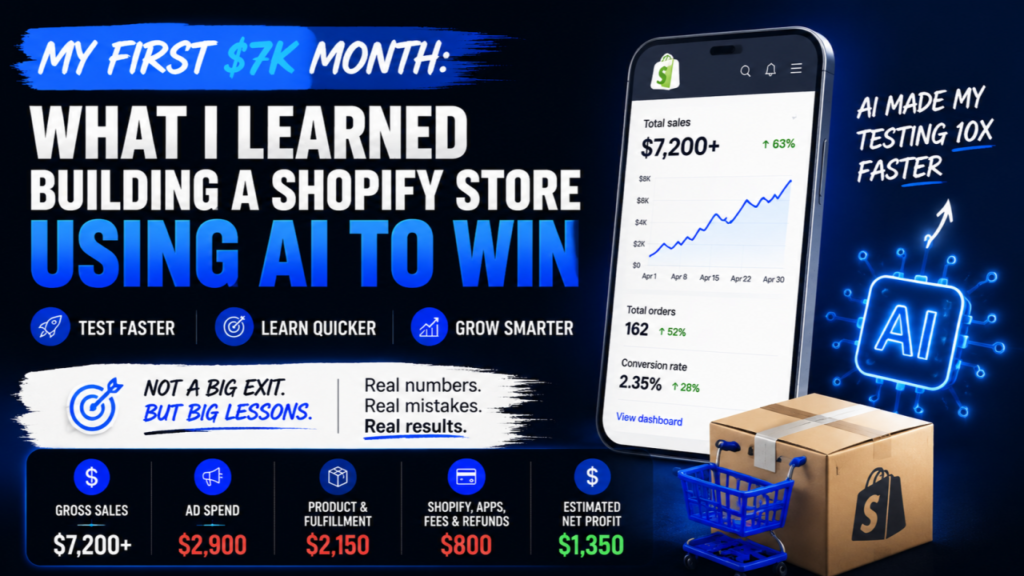
Last month, my store generated a little over $7,200 in sales.
The numbers:
💰 Gross sales: ~$7,200
📈 Ad spend: ~$2,900
📦 Product + fulfillment: ~$2,150
⚙️ Shopify, apps, fees & refunds: ~$800
✅ Estimated profit: ~$1,350
Is this a huge success story? No.
There are many businesses doing far bigger numbers.
But for me, this first milestone was valuable because it proved one thing:
The store could actually sell.
More importantly, it showed me where the real challenges were.
And surprisingly…
It wasn’t building the store.
The Store Was Never The Hard Part
When I started, I thought the biggest challenge would be:
- Building the website
- Finding the right theme
- Setting up checkout
- Managing orders
But Shopify already solved most of those problems.
The difficult part was not creating a store.
The difficult part was getting the right people to see it.
Distribution was the real game.
The Hardest Part: Creating Ads That Actually Work
Everyone says:
“Just test more creatives.”
Sounds simple.
But when you start from zero, where do you get those creatives?
Your options are usually:
❌ Use the same supplier videos as everyone else
❌ Hire creators
❌ Send products overseas
❌ Write briefs
❌ Wait for content
❌ Request revisions
❌ Edit everything together
And after spending weeks creating content, Meta might decide in 24 hours:
“People are not interested.”
Start again.
How AI Changed My Testing Process
At first, I used AI completely wrong.
I would ask:
“Create me a winning advertisement.”
The result?
Usually something that looked impressive…
but didn’t actually sell.
The videos had:
✨ Beautiful scenes
✨ Perfect lighting
✨ Cinematic camera movements
But they felt like AI demonstrations, not real ads.
And customers don’t buy because something looks impressive.
They buy because they understand:
What problem does this solve? Why should I care? Why should I buy now?
The Biggest Shift: Stop Creating Ads. Start Running Tests.
The biggest change was treating every video as an experiment.
Instead of making one “perfect” ad, I started testing:
🎯 Different hooks
🎯 Different opening seconds
🎯 Different customer angles
🎯 Different product demonstrations
Same product.
Same offer.
Different approach.
If the first 3 seconds failed → change the hook.
If the idea worked but the person felt unnatural → change the creator.
If one scene looked wrong → fix that scene.
Don’t rebuild everything.
The Ads That Worked Were Actually Simple
The funniest discovery:
The most beautiful videos were often the worst performers.
They looked amazing.
But they didn’t feel native.
The ads that worked looked more like:
📱 A normal TikTok video
👤 A creator explaining a problem
🔍 A simple product demonstration
⚡ One clear benefit
No complicated storytelling.
No unnecessary effects.
Just:
Problem → Solution → Reason to Buy
My Biggest Mistake: Confusing Volume With Testing
AI makes it easy to create 20 videos.
But creating 20 videos doesn’t mean you tested 20 ideas.
Sometimes I was just creating:
20 versions of the same bad idea.
Different backgrounds.
Different people.
Same weak message.
The real question is not:
“How many ads did I create?”
The real question is:
“How many different customer insights did I test?”
AI Is Not The Business. It’s The Accelerator.
AI didn’t:
❌ Find my winning product
❌ Fix my offer
❌ Build my website
❌ Make ads cheaper
What AI changed was the speed between:
💡 Idea → Creative → Customer Feedback → Improvement
Before:
One idea could take weeks.
Now:
I can test multiple angles within days.
That speed creates learning.
And learning creates growth.
The Biggest Lesson From My First Month
Ecommerce success is not about finding one magic product.
It’s about building a system:
✅ Find opportunities
✅ Test quickly
✅ Learn from failures
✅ Improve continuously
Most things I created at the beginning didn’t work.
But every failed test gave me more information.
The goal is not to avoid failure.
The goal is to fail faster and learn cheaper.
My first month ended with $7K+ in sales.
Not a life-changing number.
But it completely changed how I think about ecommerce growth, content creation, and AI.
The future is not about AI replacing entrepreneurs.
It’s about entrepreneurs who use AI moving faster than those who don’t.
Curious to hear from other ecommerce operators:
What’s the biggest challenge you face today — finding products, creating content, running ads, or scaling operations? 🚀