
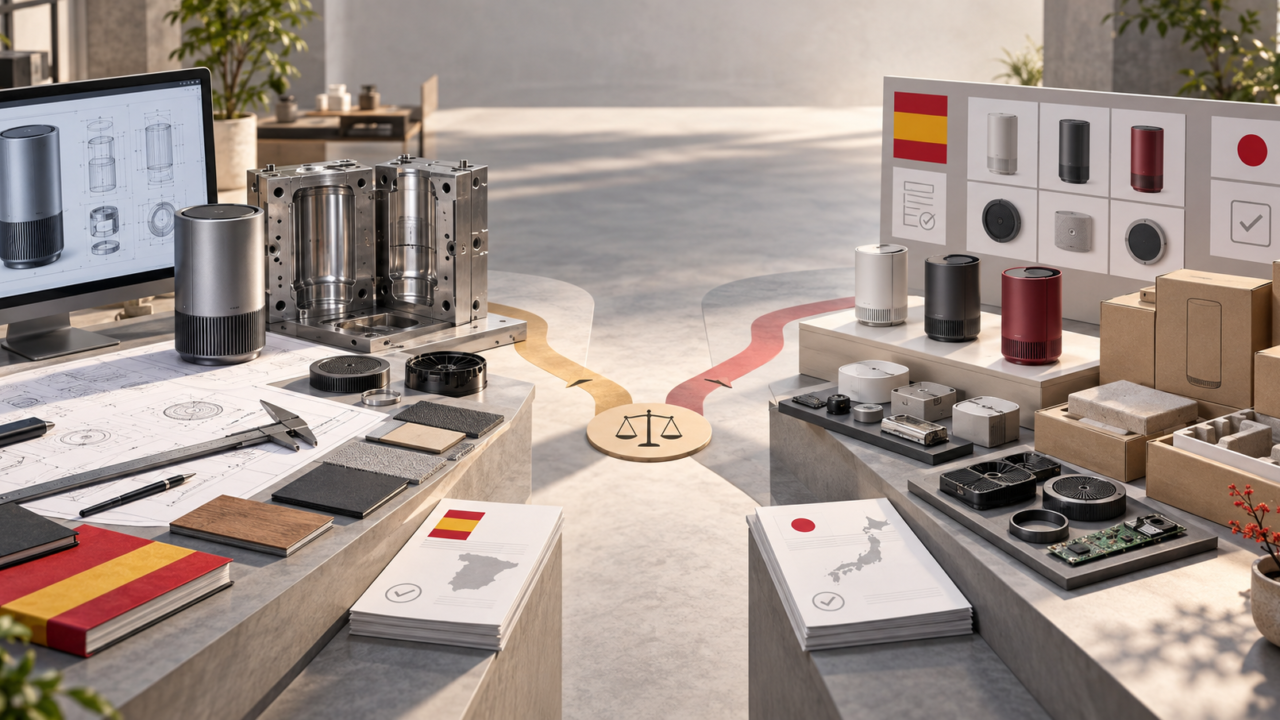
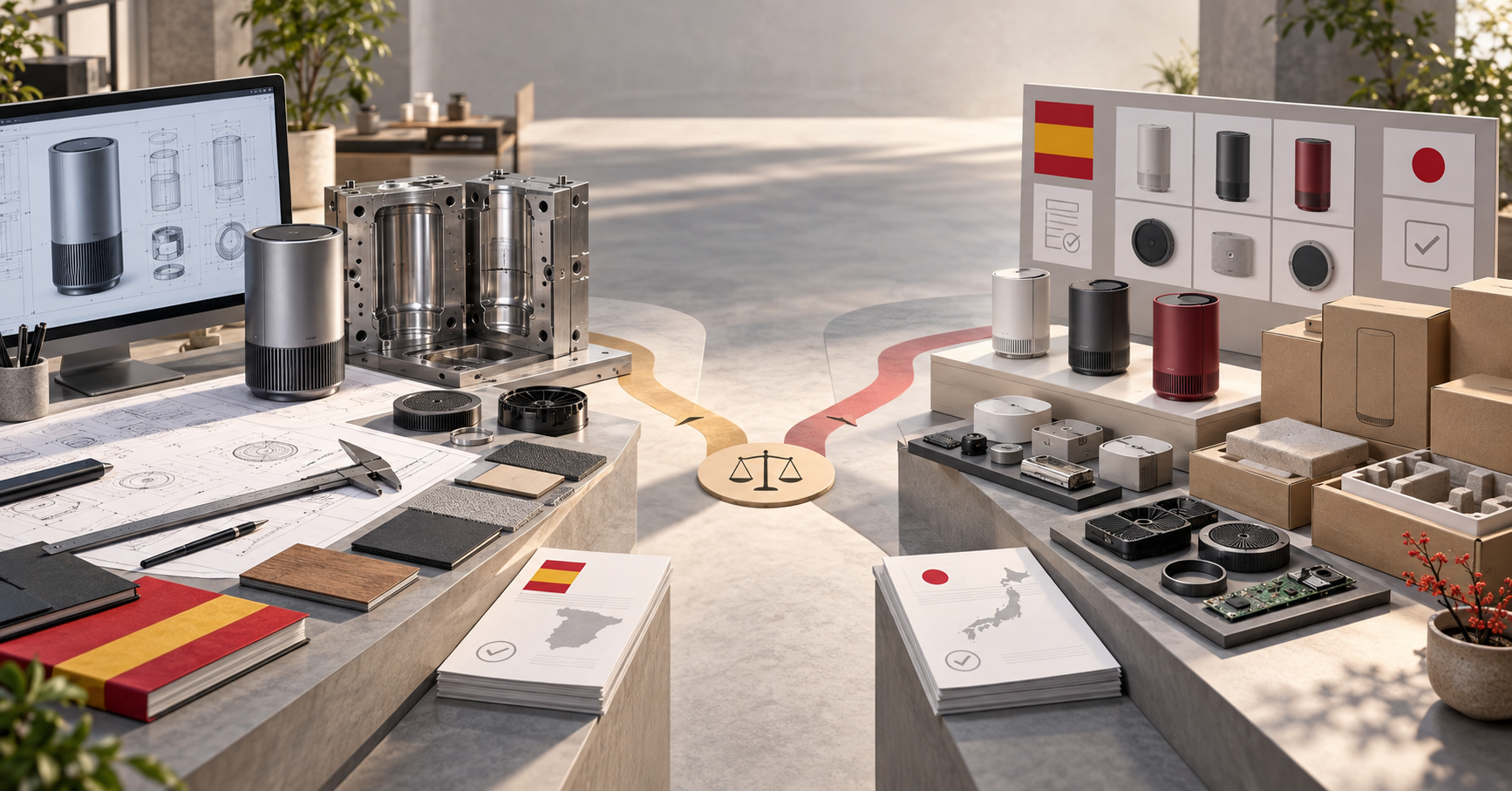
OEM and ODM are different ways to divide product development and manufacturing responsibility. The right choice depends on how much differentiation your brand needs, how quickly you need a validated product, and how much control you can support across specifications, tooling, IP, and quality. For Spain and Japan, the commercial decision should also include packaging, documentation, and destination-market requirements.
Key Takeaways
- Use ODM when speed and an existing product base matter more than deep product ownership.
- Use OEM when your specification, design, tooling, or product differentiation is central to the business.
- Treat sample approval, IP, quality, packaging, and change control as part of the manufacturing decision.
OEM and ODM in practical terms
| Model | Buyer typically controls | Supplier typically contributes | Main decision risk |
|---|---|---|---|
| OEM | Product design, specification, brand requirements, and often tooling or artwork | Manufacturing capability, materials, process, and production execution | Development cost, IP control, and production consistency |
| ODM | Market positioning, selected modifications, branding, packaging, and acceptance criteria | Existing product design, development base, and manufacturing process | Limited differentiation, shared design, and change constraints |
The labels are not enough to choose a supplier. Ask which design files, molds, materials, test results, artwork, and production knowledge belong to whom, and how the relationship handles future changes.
A decision framework for Spain and Japan
- Choose an ODM path when you need to validate demand quickly, can accept a more standardized base product, and have a clear packaging and brand-control brief.
- Choose an OEM path when the product specification, function, form factor, or IP is a core reason customers choose your brand.
- Use a staged approach when the team needs to test a product concept first and invest in deeper customization after demand and quality are validated.
A Spanish brand may prioritize retail-ready packaging and a path into local distribution. A Japanese brand may prioritize precise specifications, consistent batch quality, and disciplined supplier communication. These are not separate manufacturing models, but they should shape the requirements and supplier evaluation.
Control the path from sample to production
- Document the product brief, target customer, use case, and destination markets.
- Confirm the supplier’s ownership and reuse rights for designs, tooling, and components.
- Approve a sample against measurable specifications.
- Define the production release, inspection checkpoints, packaging, and change process.
- Record the final commercial version and review the first production batch.
Do not treat OEM or ODM as a one-time label in a supplier pitch. Treat it as a governance choice that affects every later purchase.
Map the development work before choosing a label
List the work required to bring the proposed product to an approved production version. Include concept development, industrial design, engineering, component selection, sampling, packaging, testing, and production documentation. Assign an owner to each activity and identify the evidence needed at its completion.
Ask the supplier which parts already exist and which parts must be developed. A proposal described as ODM may still require significant changes to fit your market. An OEM arrangement may still depend on supplier engineering input. The commercial label is a starting point; the actual division of work belongs in the project brief.
For a hypothetical Spanish homewares brand, adapting an existing product might reduce some development tasks while still requiring packaging and material validation. For a hypothetical Japanese brand seeking a distinct functional feature, greater design control might justify a different arrangement. These examples describe possible decisions, not proven outcomes or universal preferences in either market.
Compare total project commitments, not only unit price
Ask for separate quotations for development, samples, tooling, test work, packaging setup, and recurring production. Identify which costs are payable if the project stops after a sample. Ask whether a unit price assumes a particular quantity, material, component source, or forecast commitment.
Build a comparison for the first production run and a separate comparison for replenishment. A project with a lower initial development bill may still have higher recurring cost or less flexibility. A more customized project may require additional validation each time a component changes. Keep those assumptions visible rather than presenting a single unit price as the complete commercial answer.
Include the internal work your team must supply. Someone must approve specifications, resolve sample comments, coordinate destination requirements, and authorize changes. If your team lacks that capacity, identify the support required before selecting the model. Outsourcing manufacturing does not remove the need for a product owner.
Document ownership and access with appropriate advice
List the assets involved: drawings, digital files, molds, fixtures, firmware where relevant, packaging artwork, samples, and technical records. For each asset, ask who owns it, who may use it, where it is held, and what happens if you change manufacturers. Avoid assuming that paying a tooling invoice automatically answers every ownership or access question.
Have the actual agreements reviewed by qualified advisers for the transaction and relevant jurisdictions. This operational checklist does not determine intellectual property rights. It helps your procurement team identify the questions that need a clear contractual answer before the project creates valuable assets or depends on exclusive access.
If exclusivity is important, define the product, market, period, permitted variations, and evidence required to monitor the arrangement. Do not rely on a general sales statement that a design is “yours” without clarifying what that means for the specific assets and commercial relationship.
Release production through agreed decision gates
Use separate approvals for the development brief, sample, production specification, packaging, and first production release. At each gate, record unresolved items and the person authorized to accept them. A visually appealing sample does not establish that every functional, labeling, or manufacturing requirement has been validated.
After the first run, compare production evidence and receiving feedback with the approved baseline. Record improvements as controlled changes. Whether you chose OEM or ODM, the durable asset is a repeatable product and approval record that your team can use for the next order.
How Fishgoo Helps
Fishgoo can support supplier discovery, OEM/ODM communication, sample coordination, quality inspection, packaging, warehousing, and shipping. Ask Fishgoo to confirm what development, supplier verification, QC, and fulfillment support is available for your product category.
Discuss your China sourcing and fulfillment workflow with Fishgoo.
FAQ
Is ODM always cheaper than OEM?
Not necessarily. ODM may reduce development work, but the total cost depends on customization, tooling, MOQ, packaging, testing, IP, and production volume.
Which model is better for a new brand in Spain or Japan?
Choose based on the brand’s differentiation, resources, target timeline, and quality requirements. A staged path can reduce early commitment while preserving an option to customize later.
Who owns an OEM product design?
Ownership depends on the contracts, design contribution, tooling, and local legal context. Get professional legal advice and define ownership and permitted use before production.
See Also
Product Specification Sheets for China Manufacturing
Reducing Commercial Returns Through Sourcing, QC, and Fulfillment Controls
How Traditional Importers Can Use Chinese Sourcing Platforms Across Language Barriers
How to Evaluate an Integrated China Sourcing and Fulfillment Partner
How Traditional Importers Should Choose a China Sourcing Platform